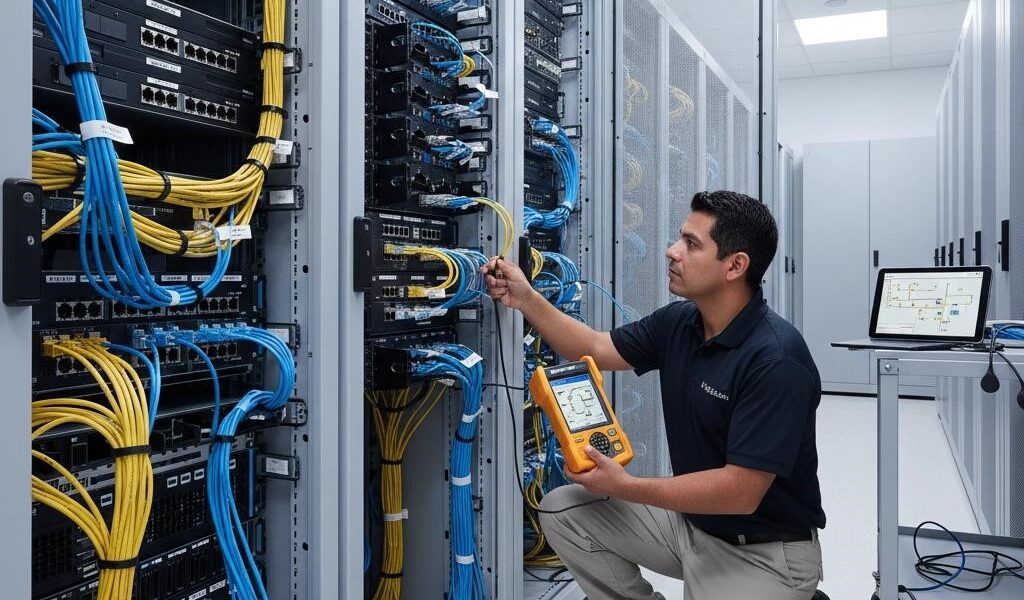


In today’s connected world, a reliable network is no longer a luxury. For factories, schools, hospitals, residential estates, farms, commercial facilities and large institutions, network infrastructure has become a critical part of daily operations.
A large compound can have multiple buildings, departments, gates, offices, production areas and remote facilities spread across a wide geographical area. Connecting all these locations requires more than installing a few Wi-Fi access points. It requires a properly designed, scalable and secure network infrastructure that provides seamless connectivity from the main communication room to every operational area.
At Fibrecom Solutions, we design and deploy end-to-end network infrastructure that connects buildings, people, devices, security systems and business operations.
Why Large Compounds Need Proper Network Infrastructure
A large facility may depend on connectivity for almost every aspect of its operations.
A factory may require connectivity between production lines, offices, warehouses, CCTV cameras and access-control systems.
A school may need connectivity across classrooms, laboratories, administration blocks, libraries, staff offices and student areas.
A hospital may depend on reliable connectivity for administration, medical systems, laboratories, CCTV, access control and communication.
An estate may require connectivity between residential blocks, management offices, gates, parking areas, CCTV systems and shared facilities.
A farm may need connectivity between offices, greenhouses, warehouses, irrigation systems, security points and remote operational areas.
Without a properly planned infrastructure, these environments can experience dead zones, network congestion, unreliable connections, security vulnerabilities and difficult maintenance.
The solution is to build the network as an integrated infrastructure from the beginning.
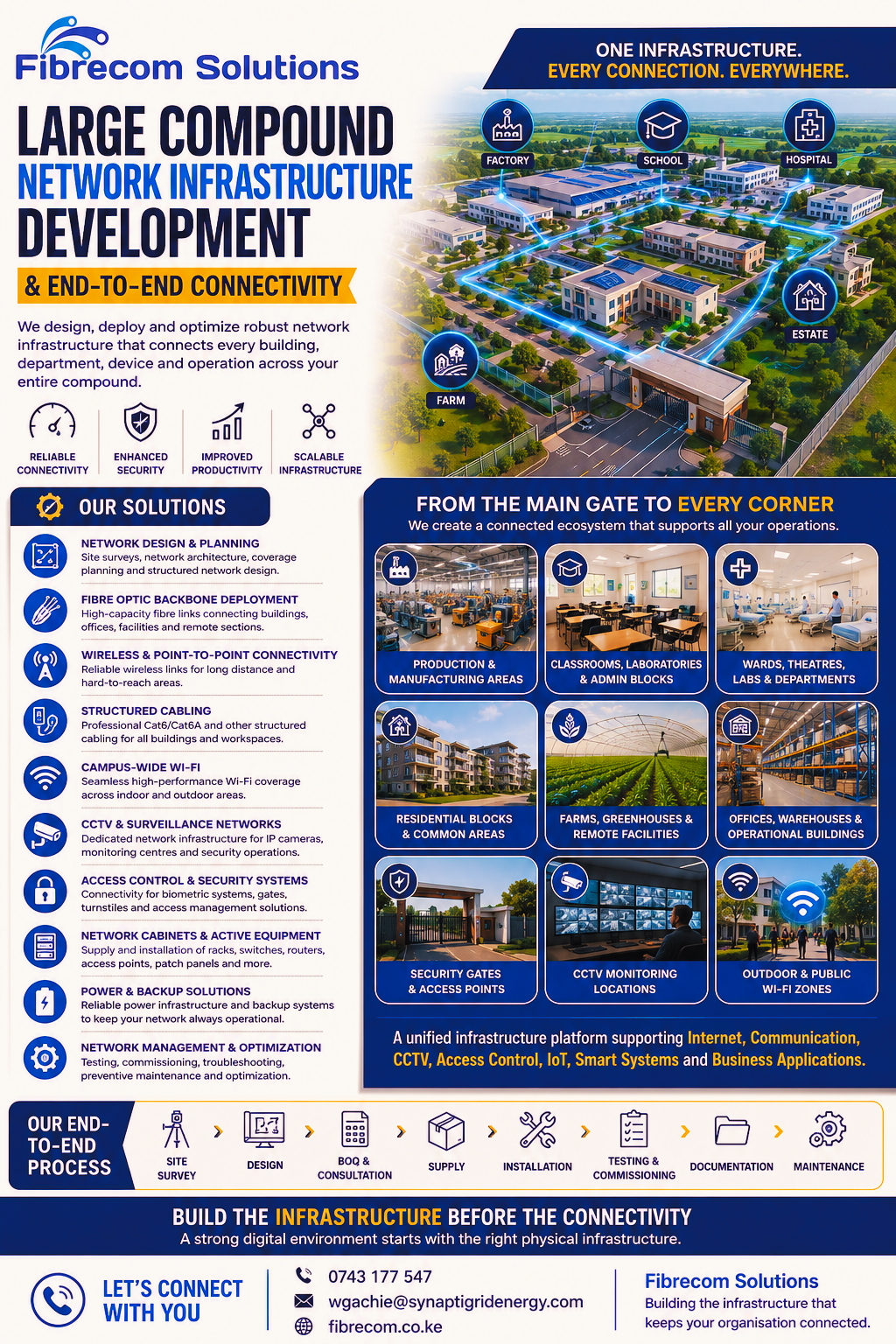
From the Main Gate to Every Corner
Large-compound networking requires a backbone capable of carrying connectivity across the entire site.
The infrastructure can begin at a central communication or server room and extend to different buildings and operational zones through a combination of fibre optic, structured cabling and wireless connectivity.
This creates a connected ecosystem that can support:
- Internet connectivity
- Enterprise networking
- Campus-wide Wi-Fi
- CCTV surveillance
- Access control
- Voice and communication systems
- IoT devices
- Smart building systems
- Business applications
- Monitoring and management systems
The objective is simple: every critical area should have reliable and appropriately designed connectivity.
Key Network Infrastructure Solutions
1. Network Design and Planning
A successful network starts with proper planning.
Before installation, a professional network project should consider:
- Site layout
- Number of buildings
- Distances between buildings
- User capacity
- Bandwidth requirements
- Future expansion
- Fibre routes
- Wireless coverage
- Equipment locations
- Security requirements
- Power availability
A site survey helps identify the most suitable infrastructure and prevents expensive redesigns later.
2. Fibre Optic Backbone Deployment
For large compounds, fibre optic connectivity provides a high-capacity backbone between buildings and critical locations.
Fibre can connect:
Main Data Room → Distribution Cabinets → Building Network Rooms → End Users and Devices
It is particularly useful where buildings are separated by significant distances or where high-speed, reliable communication is required.
Fibre infrastructure can support offices, production facilities, schools, hospitals, warehouses, residential blocks and remote operational areas.
3. Wireless and Point-to-Point Connectivity
Not every location is easy or economical to connect using physical cabling.
Remote farms, security gates, outdoor facilities and buildings separated by difficult terrain may benefit from point-to-point or point-to-multipoint wireless links.
Wireless connectivity can extend the network to areas where trenching or fibre deployment may be challenging.
The right solution depends on distance, line of sight, capacity, environmental conditions and the required level of reliability.
4. Structured Cabling
Inside buildings, structured cabling provides the foundation for reliable connectivity.
Professional installation of Cat6/Cat6A and related structured cabling infrastructure can support:
- Computers
- IP phones
- Wireless access points
- CCTV cameras
- Printers
- Access-control systems
- Smart devices
- Network equipment
Proper labelling, termination, testing and documentation are essential for long-term reliability and easier maintenance.
5. Campus-Wide Wi-Fi
Large facilities need more than a single wireless router.
A campus-wide Wi-Fi solution requires strategic placement of access points based on:
- Building layout
- User density
- Coverage requirements
- Interference
- Capacity
- Outdoor requirements
A properly designed Wi-Fi network can provide connectivity across offices, classrooms, wards, common areas, warehouses, outdoor spaces and other designated locations.
Connecting Security Systems to the Network
Modern security systems increasingly depend on IP-based connectivity.
A properly designed network can support:
CCTV Surveillance
IP cameras can be connected through the network to monitoring centres, security offices and management systems.
Access Control
Biometric readers, card systems, gates and other access-control devices can communicate through the network.
Security Gates
Remote gates and access points can be connected to central management systems where appropriate.
This means the network becomes part of the organization’s overall security infrastructure rather than functioning as an isolated IT system.
Network Cabinets and Active Equipment
A large-compound deployment also requires the right equipment infrastructure.
Depending on the project requirements, this may include:
- Network racks
- Fibre termination equipment
- Patch panels
- Network switches
- Routers
- Wireless access points
- Fibre optic accessories
- Transceivers
- UPS systems
- Cable management
- Distribution cabinets
Equipment selection should be based on actual capacity, performance, environmental conditions and future expansion requirements—not simply the cheapest available option.
Power and Backup Infrastructure
Network equipment is only useful when it has reliable power.
Critical communication rooms and network cabinets may require UPS systems, power protection and appropriate backup solutions to reduce network downtime.
For facilities operating in areas affected by power interruptions, power resilience should be considered as part of the network design rather than treated as an afterthought.
Network Management and Maintenance
Deployment is only one stage of a successful infrastructure project.
After installation, the network should be:
- Tested
- Documented
- Monitored
- Maintained
- Troubleshot
- Optimised
- Periodically reviewed
Preventive maintenance helps identify issues before they become major failures.
Documentation is equally important. Fibre routes, cable schedules, equipment locations, IP addressing, rack layouts and network diagrams can significantly reduce troubleshooting time in the future.
Our End-to-End Approach
At Fibrecom Solutions, we can support large-compound infrastructure projects through an end-to-end process:
1. Site Survey
Understand the physical environment, requirements and challenges.
2. Network Design
Develop the appropriate architecture, topology and connectivity plan.
3. BOQ & Consultation
Determine materials, equipment, quantities and project requirements.
4. Supply
Provide the required network infrastructure materials and equipment.
5. Installation
Deploy fibre, structured cabling, wireless links, cabinets and network equipment.
6. Testing & Commissioning
Test connectivity, performance and infrastructure integrity.
7. Documentation
Provide relevant network and installation documentation.
8. Maintenance & Optimization
Support ongoing performance, troubleshooting and infrastructure improvements.
Building the Infrastructure Before the Connectivity
One of the biggest mistakes organisations can make is focusing only on the internet connection while overlooking the infrastructure carrying that connection.
Connectivity is only as strong as the infrastructure supporting it.
A well-designed network provides a foundation for future digital transformation. As organisations adopt cloud applications, IoT, smart security, digital learning, electronic medical systems, automation and other technologies, the underlying infrastructure must be ready to support them.
That is why large-compound network development should be approached as a strategic infrastructure project, not simply an IT installation.
Who Can Benefit?
Fibrecom Solutions’ large-compound network infrastructure services can support:
- Factories & Manufacturing Facilities
- Schools, Colleges & Universities
- Hospitals & Healthcare Facilities
- Residential & Gated Estates
- Farms & Agricultural Facilities
- Commercial & Office Complexes
- Warehouses & Logistics Facilities
- Institutions & Large Organisations
Build a Connected Future with Fibrecom Solutions
Whether you are developing a new facility or upgrading an existing compound, the right infrastructure can provide the foundation for reliable connectivity, enhanced security, improved productivity and future expansion.
From site survey and network design to fibre deployment, structured cabling, wireless connectivity, CCTV networking, access control, equipment supply, commissioning and maintenance, Fibrecom Solutions provides an integrated approach to large-compound network infrastructure development.
BUILD THE INFRASTRUCTURE BEFORE THE CONNECTIVITY.
📞 0743 177 547
📧 wgachie@synaptigridenergy.com
🌐 fibrecom.co.ke
Fibrecom Solutions — Building the infrastructure that keeps your organisation connected.