

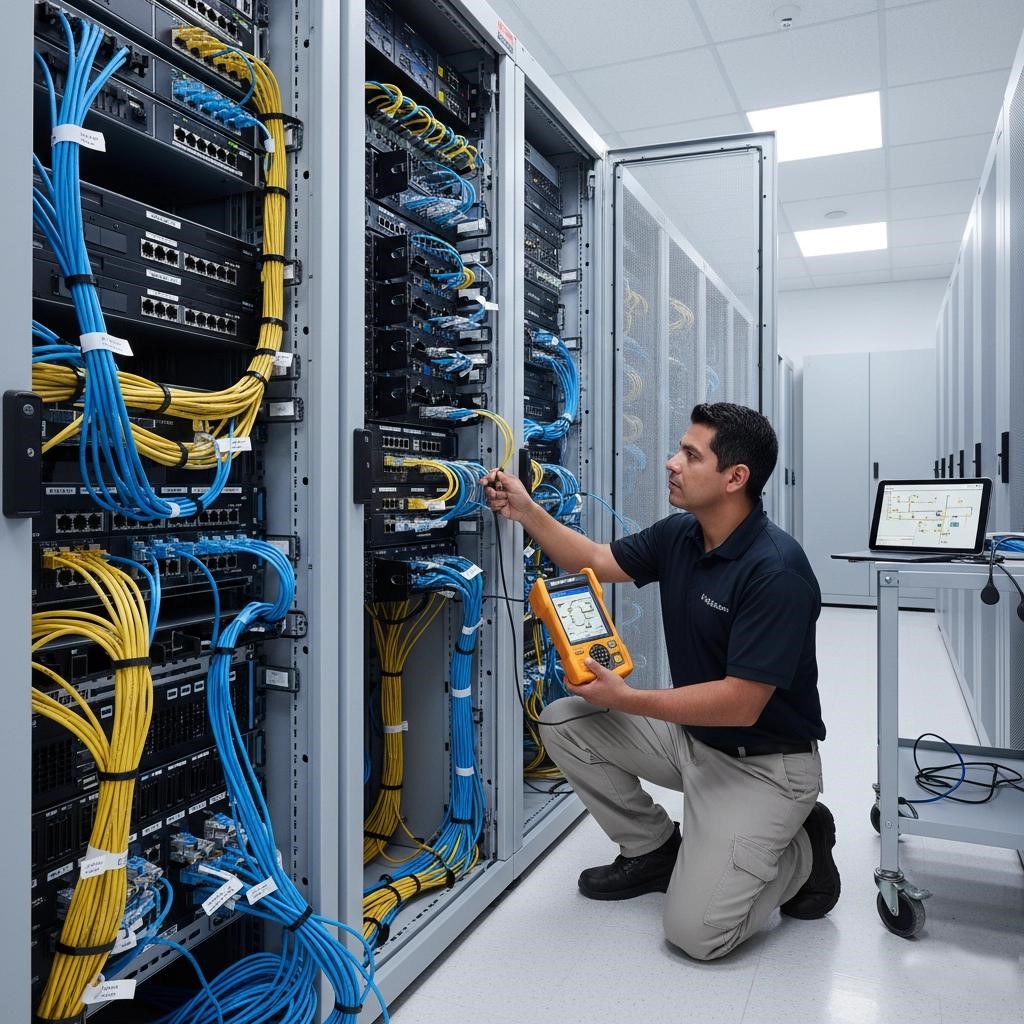

10 Hidden ICT Infrastructure Risks That Could Disrupt Your Business
How network maintenance, infrastructure audits and post-installation support help organisations prevent avoidable downtime, control costs and protect critical systems.
Your organisation’s network is working. Employees are connected, business applications are accessible, CCTV cameras are installed, and access control systems are in place.
But does that mean your ICT infrastructure is reliable, properly documented and ready to support your organisation’s future needs?
Not necessarily.
Many organisations operate with hidden infrastructure weaknesses that remain unnoticed until a network fails, a security system stops functioning, a new office cannot be connected or an urgent repair becomes more complicated than expected.
These problems are not always caused by faulty equipment. They may result from poor network design, inadequate documentation, insufficient maintenance, outdated infrastructure or a lack of structured post-installation support.
For organisations that depend on technology to deliver services, serve customers and coordinate daily operations, these weaknesses can introduce unnecessary operational and financial risks.
At Fibrecom Solutions Ltd, we help organisations assess, design, deploy, test, document and maintain ICT infrastructure to support reliable operations and future growth.
In this article, we explore ten hidden ICT infrastructure risks, their potential business consequences and the practical steps organisations can take to address them.
Poor Network Documentation
What happens when the technician who installed your network leaves, and nobody else knows how the infrastructure is connected?
This is a common challenge in organisations where network installations were completed without comprehensive documentation or where records have become outdated over time.
Missing network diagrams, unlabelled cables, undocumented fibre connections and incomplete equipment registers can make troubleshooting unnecessarily difficult.
When a fault occurs, technicians may have to trace connections manually before they can identify the actual problem. Network upgrades can also take longer because the existing infrastructure is not clearly understood.
Essential ICT infrastructure documentation may include:
- Network diagrams and topology drawings.
- Structured cabling layouts and cable labels.
- Fibre routes and fibre-core schedules.
- Rack layouts and patch-panel assignments.
- Switch-port maps and equipment registers.
- Installation and network test reports.
- Equipment warranties and maintenance records.
How to address the risk: Conduct an ICT infrastructure audit to establish what is installed, identify missing records and update documentation. Ensure changes made during maintenance or upgrades are reflected in the relevant records.
Proper documentation reduces unnecessary dependency on individual technicians and gives your organisation a stronger foundation for infrastructure management.
Single Points of Failure
A single point of failure is a component whose failure can disrupt a critical service because there is no adequate alternative or recovery arrangement.
Examples may include a critical network switch, a single uplink connecting several departments, an unprotected power source or a central network component supporting multiple business locations.
When such a component fails, the consequences can extend beyond the IT department.
Employees may lose access to business applications, warehouse operations may be interrupted, and communication between departments may be affected.
Not every organisation requires expensive redundant systems for every component. The appropriate level of resilience depends on operational requirements, the impact of downtime and the cost of recovery.
How to address the risk: Assess critical network dependencies, identify components with disproportionate operational impact and prioritise appropriate resilience, power protection and recovery measures.
Fibrecom can help assess network infrastructure and identify areas where improvements may strengthen reliability and operational continuity.
Network Downtime and Recurring Connectivity Problems
Frequent network interruptions are more than a technical inconvenience.
They can affect staff productivity, customer service, digital transactions, communication and access to essential business systems.
The challenge is that recurring connectivity problems may have several possible causes.
These include faulty cabling, overloaded network devices, poor configurations, inadequate power arrangements, ageing equipment or limitations within the wider connectivity service.
Replacing equipment without establishing the root cause can result in unnecessary expenditure while the underlying issue remains unresolved.
How to address the risk: Investigate recurring faults, review network performance, test relevant connections and identify whether the problem originates in the local infrastructure, network configuration or external connectivity.
A structured network assessment helps organisations make informed decisions about repairs, maintenance and upgrades rather than repeatedly relying on temporary fixes.
Poor Wi-Fi Coverage and Network Bottlenecks
Your organisation may be paying for a high-speed internet connection while employees continue to experience slow Wi-Fi, dropped connections and poor coverage.
Why?
Because internet bandwidth is only one part of the connectivity environment.
Wireless performance also depends on access point placement, building materials, interference, the number of connected devices, network configuration and the capacity of the supporting LAN infrastructure.
In warehouses, schools, hotels, hospitals and commercial buildings, poorly planned Wi-Fi can leave important areas with inadequate connectivity.
Adding more access points without assessing the environment may not solve the problem and can introduce additional interference or management complexity.
How to address the risk: Assess wireless coverage, user density, access point placement, switching capacity and structured cabling. Identify the actual bottlenecks before investing in additional bandwidth or equipment.
Fibrecom provides LAN and Wi-Fi infrastructure solutions designed around an organisation’s operational requirements, physical environment and expected network demand.
Poor Post-Installation Support
An infrastructure project may be completed, tested and handed over, but what happens when problems emerge several months later?
Who investigates recurring network faults? Who verifies system performance? Who updates the documentation after changes are made? Who helps the organisation plan future upgrades?
Without clear post-installation support arrangements, organisations can find themselves reacting to faults without a defined process for diagnosis, escalation and resolution.
This is particularly challenging when several contractors were involved in the original project or when the internal IT team lacks the resources to maintain every component.
How to address the risk: Establish clear post-installation support responsibilities, fault-reporting procedures, maintenance requirements and documentation processes.
Depending on the system and agreed scope, support may include troubleshooting, performance reviews, corrective maintenance, equipment checks and infrastructure upgrades.
At Fibrecom Solutions Ltd, we recognise that successful infrastructure delivery extends beyond installation. The objective is to help clients maintain a clear understanding of their infrastructure and plan for its ongoing operational needs.
CCTV and Access Control Systems That Are Not Properly Maintained
Installing CCTV cameras and access control equipment is an important step towards managing security. However, installation alone does not guarantee ongoing system reliability.
A camera may be powered on but not recording as expected. Storage capacity may be inadequate. Network interruptions may affect camera availability. Access control readers may experience recurring faults, or event records may not be reviewed regularly.
These issues can remain unnoticed until footage or access records are needed.
The supporting infrastructure matters too. Network cabling, switching, power arrangements and connectivity all contribute to the performance of networked surveillance and access control systems.
How to address the risk: Establish an appropriate inspection and maintenance process. Verify camera recording, footage retrieval, storage arrangements, connectivity and access control functionality. Investigate recurring faults and maintain records of corrective work.
Fibrecom supports organisations with CCTV and access control infrastructure, including the supporting network components that help these systems operate as intended.
The aim is to identify potential weaknesses and support informed maintenance and improvement decisions.
Unplanned Business Expansion
Infrastructure that was sufficient for a small office may not support an organisation with additional departments, more employees, new branches or expanding operational requirements.
Growth increases demand for network ports, switching capacity, wireless coverage, cabling, equipment room space and supporting power infrastructure.
Additional surveillance cameras, access control points and connected devices introduce further requirements.
When expansion takes place without infrastructure planning, organisations may encounter repeated cabling work, overloaded devices, inadequate Wi-Fi coverage and expensive modifications.
How to address the risk: Review current infrastructure capacity before expansion. Consider future user numbers, connected devices, network requirements, equipment space, cable routes and the possibility of adding new systems.
For new offices, commercial buildings, warehouses and multi-site organisations, ICT infrastructure should be considered early in the project planning process.
Fibrecom helps organisations assess existing infrastructure and plan suitable ICT solutions for new installations, expansions and network upgrades.
Ageing Equipment and Unsupported Technology
Ageing equipment is not automatically a problem. However, equipment that no longer meets operational requirements or lacks appropriate vendor support may introduce reliability, compatibility and security concerns.
Older network switches, access points and other devices may struggle to accommodate increased traffic or newer technologies. Spare parts may become harder to obtain, and repairs may become more difficult.
Continuing to operate unsuitable equipment can also create a pattern of repeated emergency repairs and unplanned replacements.
Replacing every older device immediately is not always the most economical approach.
How to address the risk: Review equipment condition, capacity, support status, compatibility and operational importance. Identify which components can remain in service, which require maintenance and which should be prioritised for replacement.
An ICT infrastructure assessment provides a basis for developing a practical upgrade plan that aligns with business needs and available budgets.
Vendor Dependency and Poor Handover
Many organisations engage separate contractors for fibre installation, structured cabling, networking equipment, Wi-Fi, surveillance and access control.
This arrangement can work effectively when responsibilities are clearly defined and all components are properly coordinated.
Problems arise when documentation is incomplete, project responsibilities overlap or each vendor understands only its own part of the installation.
When a fault occurs, the organisation may struggle to determine where the problem originates or which contractor should address it.
Poor handovers can also leave internal teams without the information needed to maintain or expand the installed infrastructure.
How to address the risk: Establish clear project responsibilities, require appropriate testing and documentation, and ensure the handover process captures the information needed for ongoing management.
Working with an ICT infrastructure solutions partner can help coordinate the assessment, design, supply, deployment, testing and documentation of connected infrastructure components.
Fibrecom helps organisations take a more coordinated approach to infrastructure delivery, reducing gaps between individual installations and supporting clearer operational accountability.
Infrastructure That Cannot Scale With Your Business
An ICT infrastructure solution should meet current requirements while taking reasonable account of future needs.
However, some installations are designed around immediate requirements without sufficient consideration for growth, additional devices, new applications or changing operational demands.
The result may be insufficient cabinet space, limited switching capacity, congested cable routes, inadequate wireless coverage or costly rework when new systems are introduced.
This is particularly relevant to developers, construction contractors, expanding businesses and organisations establishing new facilities.
How to address the risk: Assess expected growth during the design stage. Review network capacity, structured cabling, equipment room requirements, fibre connectivity and provisions for additional devices and systems.
A scalable design does not mean overspending on capacity that will never be used. It means making informed decisions today that reduce avoidable constraints tomorrow.
Fibrecom supports ICT infrastructure planning and deployment to help organisations establish solutions aligned with their current requirements and anticipated growth.
Why ICT Infrastructure Assessments Matter
Many infrastructure problems are difficult to identify through visual inspection alone.
A network cabinet may appear organised while the documentation is incomplete. Wi-Fi may work in one office but perform poorly in another. A CCTV system may appear operational while recording or storage issues remain undetected.
An ICT infrastructure assessment helps establish a clearer picture of the existing environment.
Depending on the agreed scope, an assessment may cover:
- Network infrastructure: Fibre, structured cabling, switches, connectivity and network topology.
- LAN and Wi-Fi: Coverage, performance concerns, capacity and potential bottlenecks.
- Equipment and cabinets: Device condition, organisation, available space and supporting power arrangements.
- Surveillance and access control: Relevant connectivity, equipment functionality and supporting infrastructure.
- Documentation and handover: Network diagrams, cable labels, equipment registers, test reports and maintenance records.
- Maintenance and support: Recurring faults, outstanding corrective work and opportunities for preventive maintenance.
- Future requirements: Expansion plans, additional devices and potential upgrade priorities.
The outcome should be a practical understanding of identified issues, their operational significance and the recommended next steps.
Not every finding requires immediate replacement. Some issues may be resolved through documentation updates, configuration changes, targeted repairs or improved maintenance procedures. Others may require an upgrade or a broader infrastructure overhaul.
The important step is to make decisions based on the actual condition and requirements of the infrastructure.
How Fibrecom Solutions Ltd Helps Organisations Manage Infrastructure Risk
Fibrecom Solutions Ltd is an ICT infrastructure design, deployment and implementation partner supporting organisations that need reliable, well-planned and properly documented technology infrastructure.
Our approach brings together assessment, design, equipment supply, deployment, testing, documentation, handover and post-installation support according to project requirements.
Our services include:
- ICT infrastructure assessments and audits.
- Fibre optic and last-mile infrastructure.
- Structured cabling and LAN solutions.
- Enterprise Wi-Fi design and deployment.
- Network equipment supply and installation.
- Network upgrades and infrastructure overhauls.
- CCTV and surveillance infrastructure.
- Access control infrastructure.
- Equipment room and network cabinet solutions.
- Infrastructure testing, documentation and handover.
- Post-installation support and preventive maintenance.
We support organisations across commercial property, construction, education, healthcare, hospitality, NGOs, warehouses and other sectors that depend on reliable ICT infrastructure.
Whether you are managing an existing network, preparing a new facility, expanding your operations or reviewing the condition of installed security systems, Fibrecom can help you assess your requirements and identify suitable solutions.
Our objective is to help clients make informed infrastructure decisions, address operational gaps and establish systems that can be maintained and developed as business needs change.
Do Not Wait for a Failure to Discover Your Infrastructure Weaknesses
The biggest ICT infrastructure risk is not always the fault that brings your network down.
It may be the missing documentation that delays repairs, the Wi-Fi dead zone that reduces productivity, the unsupported device that limits expansion or the surveillance system that has not been adequately checked.
These problems can remain hidden while everything appears to be working.
A proactive approach to infrastructure management helps organisations identify potential weaknesses, improve documentation, plan maintenance and prioritise investment before avoidable problems escalate.
Your network may be working today. The question is whether your infrastructure is properly managed, adequately supported and ready for tomorrow’s demands.
Request an ICT Infrastructure Assessment
Do you have recurring network problems, unreliable Wi-Fi, undocumented cabling, concerns about CCTV or access control, or infrastructure that needs upgrading?
Fibrecom Solutions Ltd can help you assess your current infrastructure and identify practical next steps.
Contact us today to discuss your requirements.
Fibrecom Solutions Ltd
- Email: info@fibrecom.co.ke
- Website: https://fibrecom.co.ke
- Phone: 0743 177 457
Reliable Technology Infrastructure, Delivered Right.



Hi,how are you
Hello.