

In modern security environments, surveillance is no longer just about installing cameras. A reliable CCTV system depends on the network infrastructure connecting cameras, switches, fibre backbones, power systems, recording equipment and monitoring platforms.
Whether you are securing a residential estate, commercial building, school, hospital, industrial facility, warehouse or corporate campus, the quality of the network behind your surveillance system can determine how effectively it performs.
At Fibrecom Solutions Ltd, we provide end-to-end network infrastructure solutions designed to support reliable, scalable and secure surveillance systems.
Why a Strong Network Matters for Surveillance
Modern IP cameras continuously generate video data. High-resolution cameras, multiple camera locations, remote monitoring and video analytics can place significant demands on the network.
A poorly designed network can lead to:
- Interrupted video feeds
- Delayed or lost footage
- Poor camera connectivity
- Network congestion
- Unstable remote monitoring
- Power-related downtime
- Difficult troubleshooting
- Limited room for future expansion
Installing the cameras is therefore only one part of the project.
The network is the backbone that connects the entire surveillance ecosystem.
The Key Components of a Modern Surveillance Network
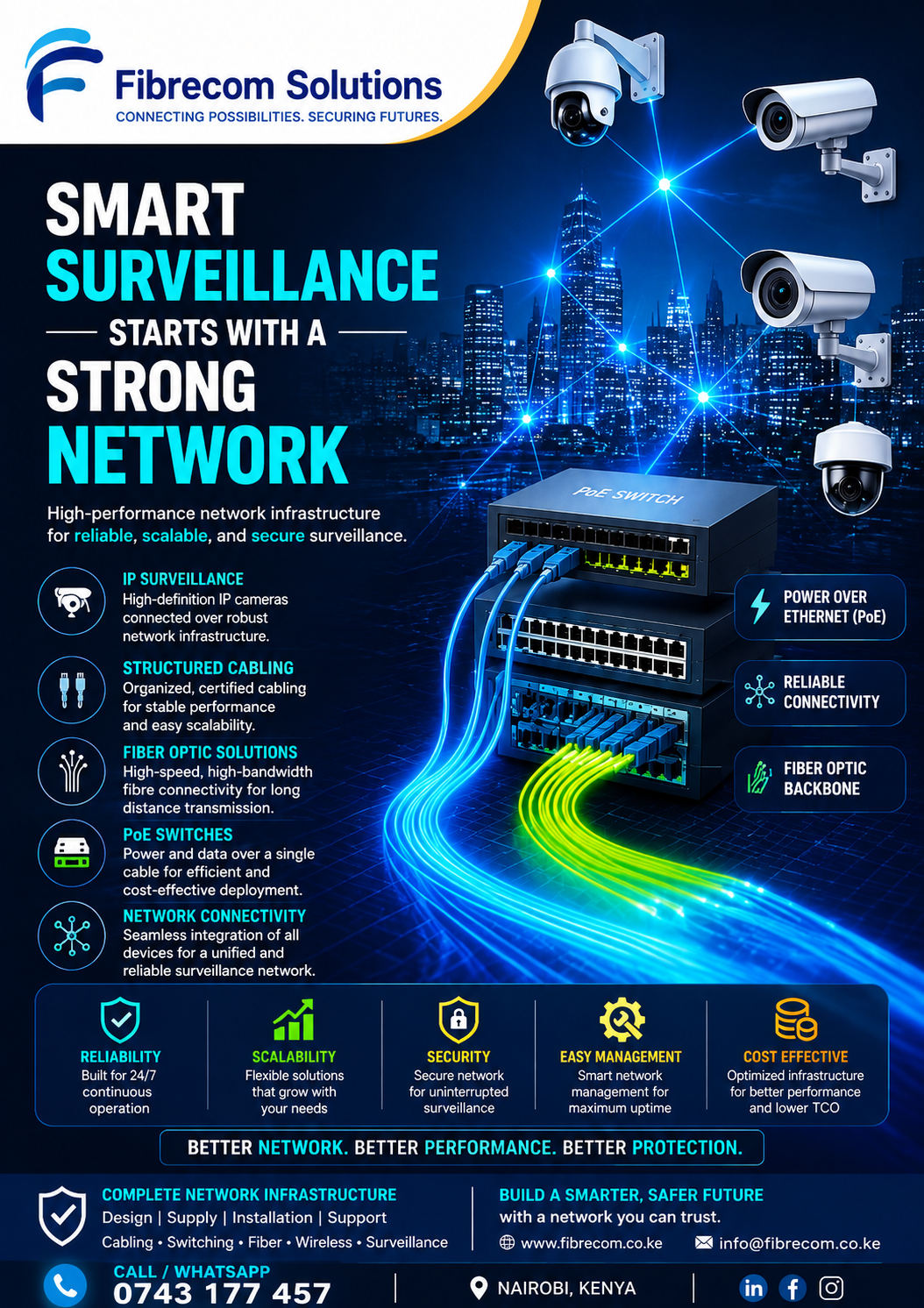
1. IP Surveillance
IP surveillance provides organizations with network-connected cameras capable of transmitting video across a structured network.
With the right infrastructure, cameras can be connected to centralized recording systems, monitoring rooms and authorized remote users.
This makes IP surveillance particularly suitable for organizations managing multiple buildings, large compounds or geographically distributed camera locations.
2. Structured Cabling
A reliable surveillance system starts with proper physical connectivity.
Cat6 and Cat6A structured cabling can provide dependable connections between cameras, PoE switches and other network equipment.
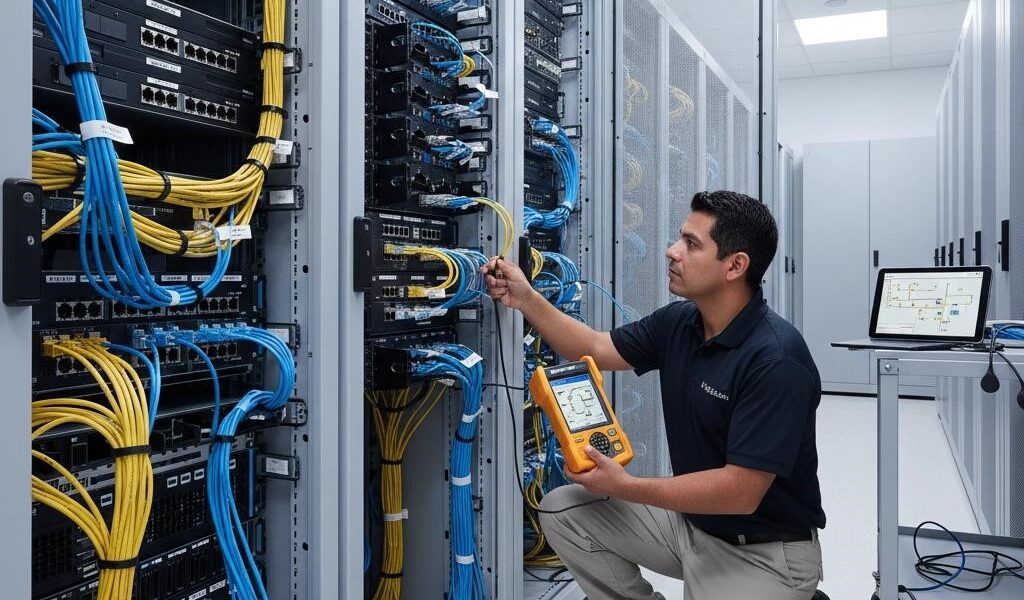
Professional cable installation should consider:
- Cable routes
- Distance
- Termination
- Cable management
- Environmental conditions
- Network cabinet organization
- Future expansion
Properly installed structured cabling makes troubleshooting easier and provides a foundation for scaling the surveillance system.
3. Fibre Optic Backbone Infrastructure
Large compounds often have cameras distributed across multiple buildings or long distances.
This is where fibre optic infrastructure becomes particularly valuable.
A fibre backbone can connect different buildings, security zones and network cabinets while providing high-capacity connectivity for surveillance traffic.
Fibre can be especially useful for:
- Industrial facilities
- School campuses
- Residential estates
- Corporate campuses
- Warehouses and logistics facilities
- Healthcare facilities
A well-designed fibre backbone also provides room for future digital services beyond CCTV.
4. PoE Switches and Networking
IP cameras often require both network connectivity and power.
Power over Ethernet (PoE) allows compatible cameras to receive power and data through the network cabling.
A properly designed PoE network can simplify installation while reducing the need for separate power connections at every camera location.
Network switches also provide the connectivity required to bring multiple cameras together and connect them to the wider surveillance infrastructure.
5. Network Design and Connectivity
Simply connecting cameras to switches does not automatically create an efficient surveillance network.
The network should be designed around the number of cameras, resolution, traffic requirements, locations and future expansion plans.
Important considerations include:
Bandwidth → IP addressing → VLANs → Network segmentation → Switch capacity → Uplink capacity → Storage → Remote access → Scalability
Network segmentation can also help separate surveillance traffic from other business applications, improving organization and network management.
6. Wireless Connectivity for Difficult Locations
Not every camera location can be reached easily with physical cabling.
Remote gates, perimeter areas, construction zones and separated buildings may require wireless connectivity.
Professionally designed wireless links can help connect these locations to the main surveillance network where running cables is difficult or impractical.
The solution should be designed around distance, environmental conditions, line-of-sight and required bandwidth.
7. Power and Backup Solutions
A surveillance system is only useful when it is operational.
Power interruptions can affect cameras, switches, NVRs, network equipment and monitoring systems.
Integrating power backup solutions into the surveillance infrastructure can help maintain critical connectivity during power disruptions.
This is particularly important for facilities where continuous monitoring is essential.
8. Preventive Maintenance and Technical Support
Network infrastructure should not be treated as a one-time installation.
Over time, organizations add cameras, expand buildings, modify networks and introduce new technologies.
Preventive maintenance helps identify potential issues before they result in major downtime.
Maintenance can include:
- Network inspections
- Cable testing
- Switch checks
- Fibre link testing
- Camera connectivity checks
- Power system checks
- Network performance assessments
- Fault identification
- Infrastructure upgrades
Don’t Just Install Cameras. Build the Infrastructure Behind Them.
One of the biggest mistakes organizations make is focusing entirely on the cameras while overlooking the infrastructure supporting them.
A modern surveillance environment should be viewed as an integrated system:
Cameras
↓
Structured Cabling
↓
PoE Switching
↓
Fibre/Wireless Backbone
↓
Core Network
↓
NVR/Storage
↓
Monitoring & Management
When these components are properly planned and integrated, organizations can build a surveillance environment that is reliable, scalable and easier to manage.
Where Can Fibrecom’s Surveillance Infrastructure Solutions Be Applied?
Our network infrastructure solutions can support a variety of environments, including:
Residential Estates
Support perimeter surveillance, access points, common areas and security control rooms.
Commercial Buildings
Connect cameras across offices, parking areas, entrances, reception areas and other critical zones.
Industrial Facilities
Support surveillance across production areas, warehouses, yards and perimeter zones.
Schools and Institutions
Create connected surveillance infrastructure across classrooms, administration blocks, gates and shared facilities.
Healthcare Facilities
Support surveillance across entrances, parking areas, corridors and other designated security areas.
Warehouses and Logistics
Connect cameras across loading bays, storage areas, yards and access points.
Construction Sites
Provide network connectivity for temporary or expanding surveillance deployments.
Fibrecom Solutions: From Design to Support
At Fibrecom Solutions Ltd, we bring together multiple infrastructure components into one coordinated solution.
Our project lifecycle can cover:
Design → Supply → Installation → Configuration → Testing → Commissioning → Maintenance
Our capabilities include:
- Network infrastructure
- Structured cabling
- Fibre optic solutions
- Wireless connectivity
- PoE networking
- CCTV infrastructure
- Power and backup solutions
- Network configuration
- Preventive maintenance
- Technical support
This approach enables organizations to work with one infrastructure partner instead of managing disconnected components from multiple providers.
Build a Smarter, Safer Future
The future of surveillance is connected.
As organizations adopt higher-resolution cameras, remote monitoring, analytics, smart buildings and other digital technologies, the network infrastructure supporting these systems becomes increasingly important.
Better network. Better performance. Better protection.
Don’t wait until your cameras start dropping offline to discover that your network infrastructure needs attention.
If you are planning a new CCTV deployment, expanding an existing surveillance system or experiencing network-related surveillance challenges, Fibrecom Solutions Ltd can help you design the infrastructure behind your security system.
📞 Talk to Fibrecom Solutions Today
Call / WhatsApp: 0743 177 457
Website: fibrecom.co.ke
Email: info@fibrecom.co.ke
Location: Nairobi, Kenya
Fibrecom Solutions Ltd
Connecting Possibilities. Securing Futures.