

End-to-End Conference Connectivity: How to Build Infrastructure That Performs Under Pressure
A modern conference is a highly connected environment. Attendees expect reliable Wi-Fi, speakers depend on cloud-based presentations, organizers need real-time registration, exhibitors require internet access, and virtual participants expect uninterrupted streaming.
This means a conference network must do much more than simply provide internet access.
It must be designed around the actual load of the event.
The most important question is not, “How many Mbps are we buying?” but rather:
“Can our entire network infrastructure handle everything that will happen simultaneously?”
That is where concurrent load analysis, capacity planning, and end-to-end network design become critical.
The Problem: A Fast Internet Connection Is Not Enough
One of the most common mistakes when planning conference connectivity is focusing only on the internet package.
An organization may purchase a high-speed connection but still experience:
- Slow Wi-Fi
- Registration delays
- Buffering during live streaming
- Interrupted presentations
- Dropped video conferences
- Poor connectivity in crowded areas
- Slow cloud applications
- Unstable connections for exhibitors
Why?
Because the performance of a conference depends on the entire network infrastructure, not just the internet connection.
The network must support multiple users, devices, applications, and services simultaneously.
Understanding Concurrent Load
Concurrent load refers to the number of users and devices actively using the network at the same time.
Consider a conference with 800 attendees.
If every attendee connects a smartphone, that’s already approximately 800 devices. Some may also connect laptops or tablets.
At the same time, the event may have:
- 20 registration devices
- 10 presentation systems
- Multiple exhibitors
- Several video conferencing sessions
- Live streaming equipment
- Digital signage
- Event management platforms
- Media teams
- Organizers and technical teams
The network could therefore be supporting well over 1,000 active devices and applications.
This is why simply calculating the number of attendees is not enough.
A professional network design must consider device density, application usage, traffic patterns, bandwidth requirements, latency, and peak demand.
Streaming Can Change Everything
Live streaming is one of the most demanding activities on a conference network.
A hybrid conference may simultaneously require connectivity for:
- Live video transmission
- Remote speakers
- Virtual attendees
- Video conferencing
- Cloud recording
- Social media broadcasting
- Content uploads
Streaming also places significant demands on upload capacity, which is often overlooked.
A network may have excellent download speeds but still struggle with live broadcasting if the upload capacity and network architecture are inadequate.
Therefore, streaming requirements should be assessed before the event and incorporated into the network design.
Presentations Need Reliable Connectivity
Modern presentations are increasingly cloud-based.
Speakers may depend on:
- Cloud storage
- Online videos
- Microsoft 365
- Google Workspace
- Web-based demonstrations
- Collaboration platforms
- Remote presenters
Imagine a keynote speaker attempting to access an important presentation while hundreds of attendees are simultaneously downloading content and streaming videos.
Without proper network planning, congestion can affect the presentation.
A professionally designed network prioritizes critical traffic and ensures that important applications receive the resources they need.
Registration Is a Critical Network Service
Registration is often overlooked when planning event connectivity.
Yet it is one of the first services attendees interact with.
Modern registration systems may depend on:
- Cloud databases
- QR-code scanning
- Online ticket verification
- Badge printing
- Payment systems
- Attendance tracking
If the network becomes congested, registration can slow down dramatically.
The result is long queues and a poor first impression.
For large conferences, registration systems should therefore be treated as mission-critical network services.
Wi-Fi Design Must Match the Venue
Conference Wi-Fi is not simply about installing several access points around a building.
A professional wireless design considers:
User Density
How many people will be in each room or section?
Device Density
How many devices will each person connect?
Physical Environment
Walls, furniture, building materials, and venue layout can affect wireless performance.
Interference
Other wireless devices and neighboring networks can affect performance.
Application Requirements
Streaming and video conferencing require more capacity than basic web browsing.
Coverage
Every area requiring connectivity should be properly assessed.
This is why Wi-Fi site surveys and capacity planning are essential for high-density conference environments.
Network Segmentation Improves Performance and Security
A conference should not necessarily operate as one large network.
Different users and systems have different requirements.
A properly designed infrastructure can create separate network segments for:
- Guests
- Speakers
- Organizers
- Exhibitors
- Registration
- Media teams
- Audio-visual systems
- Management systems
This approach provides greater control over network traffic while improving security and performance.
For example, guest browsing should not interfere with critical registration or streaming systems.
Structured Cabling: The Backbone of Connectivity
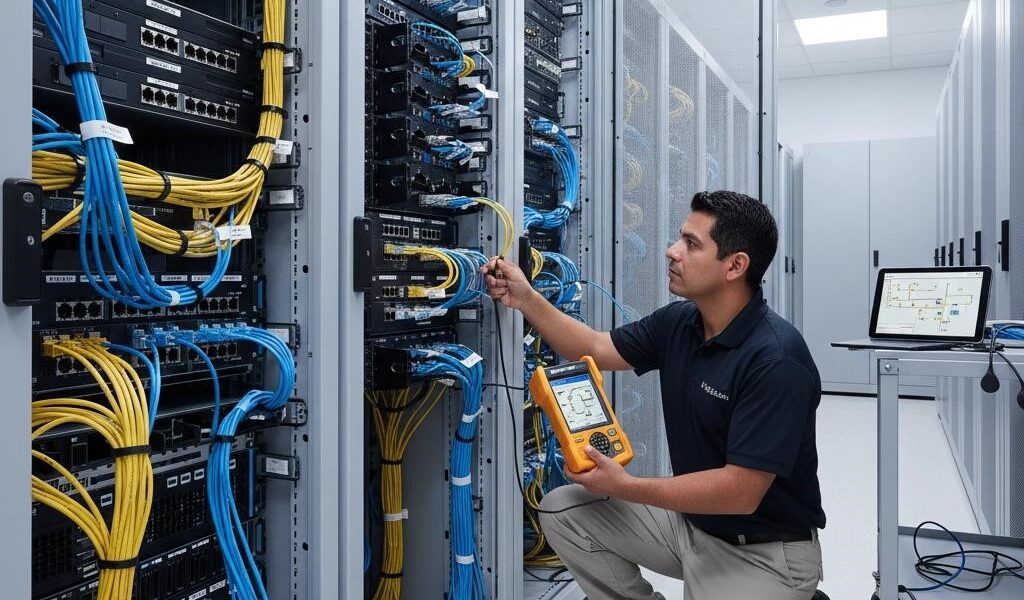
Wireless connectivity may be what attendees see, but structured cabling is often what makes the entire system possible.
Structured cabling provides reliable connections for:
- Wireless access points
- Network switches
- Servers
- Registration equipment
- Digital signage
- Audio-visual systems
- Security systems
- Streaming equipment
A professionally installed cabling infrastructure also makes troubleshooting, maintenance, and future expansion easier.
Network Monitoring During the Event
Even a well-designed network needs monitoring.
During a major conference, technical teams should be able to identify:
- Bandwidth utilization
- Access point performance
- Network congestion
- Device failures
- Connectivity issues
- Unusual traffic
- Service interruptions
Real-time monitoring allows technical teams to respond quickly before small issues become major disruptions.
Building a Resilient Conference Network
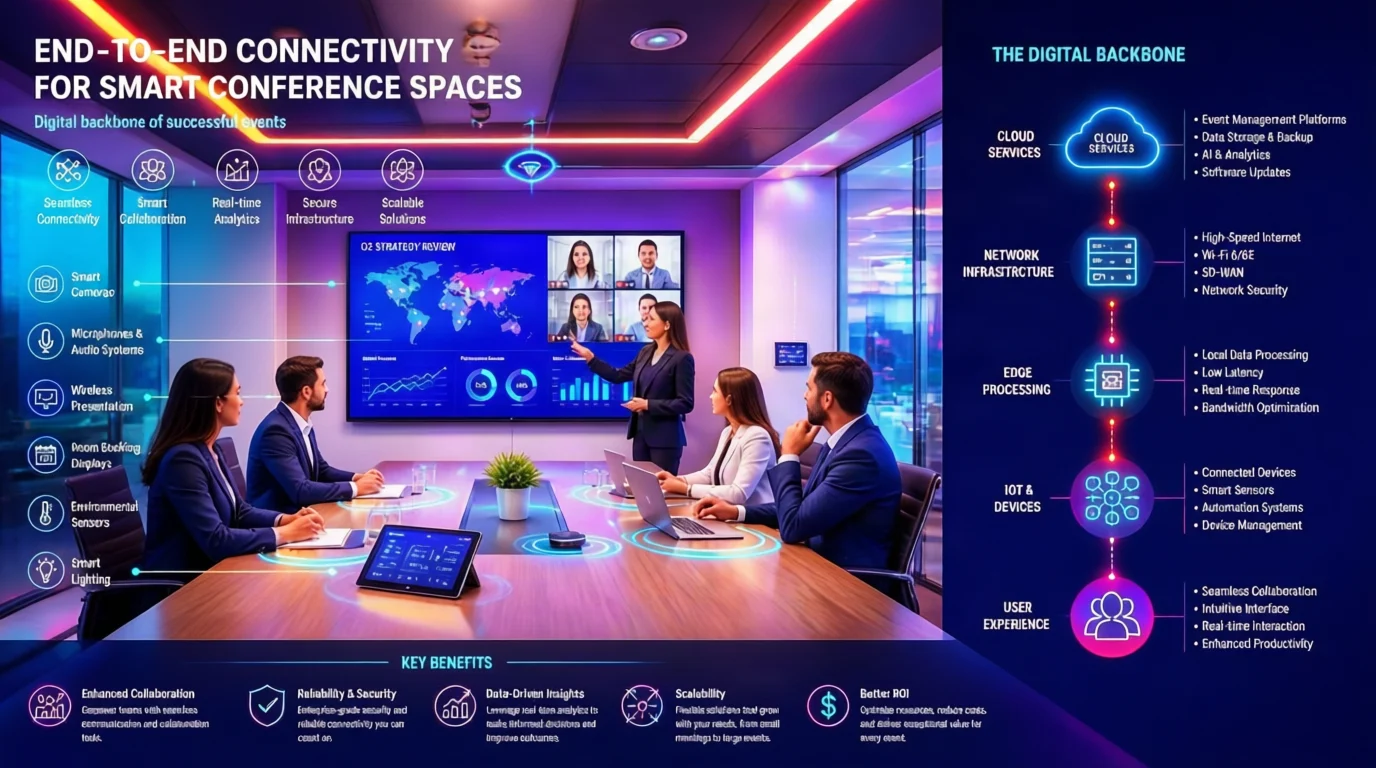
A strong conference connectivity solution should combine several layers of infrastructure.
1. Fibre Connectivity
Provides high-capacity internet access.
2. Enterprise Wi-Fi
Supports high-density wireless users.
3. Structured Cabling
Provides the physical network backbone.
4. Network Switching and Routing
Directs traffic efficiently between users, devices, and services.
5. Network Security
Protects systems and information.
6. Network Segmentation
Separates critical services and user groups.
7. Monitoring
Provides visibility into network performance.
8. Technical Support
Ensures rapid response during the event.
Together, these components create an end-to-end connectivity ecosystem.
Why Capacity Planning Should Start Before the Event
Network planning should not begin on the morning of the conference.
It should start during the event planning stage.
Before deployment, technical teams should understand:
- Expected attendance
- Number of rooms
- Number of simultaneous sessions
- Number of connected devices
- Registration requirements
- Streaming requirements
- Presentation requirements
- Exhibitor requirements
- Virtual participation
- Security requirements
- Expected peak usage
This information allows the network infrastructure to be designed around the actual requirements of the event.
The Solution: Engineer the Network Around the Event
At Fibrecom Solutions, we believe conference connectivity should be engineered—not improvised.
We help organizations develop reliable connectivity infrastructure through:
Network Assessment & Capacity Planning
We evaluate the venue, users, devices, applications, and expected peak demand.
Concurrent Load Analysis
We determine how the network is likely to perform when multiple services operate simultaneously.
Enterprise Wi-Fi Deployment
We design high-density wireless environments for reliable attendee connectivity.
Fibre & Structured Cabling
We establish the physical infrastructure required to support the network.
LAN & WAN Infrastructure
We connect event systems, cloud platforms, and remote participants.
Network Security & Segmentation
We separate critical services while protecting the network from unauthorized access.
Streaming & Hybrid Event Support
We provide infrastructure capable of supporting live broadcasting and virtual participation.
Monitoring & Technical Support
We monitor network performance and provide technical assistance throughout the event.
Conclusion: Don’t Plan for Average Usage—Plan for Peak Demand
A conference network should never be designed based on average usage.
The real test comes when everyone connects, presentations are running, registration is processing attendees, exhibitors are online, and multiple streams are being transmitted at the same time.
That is the moment when poorly designed networks fail.
A seamless conference requires infrastructure designed around concurrent load, streaming, presenting, registration, device density, security, and peak usage.
The goal is simple:
Connect everyone. Support every critical application. Keep the event running.
At Fibrecom Solutions, we design and deploy end-to-end connectivity solutions that give conference organizers the infrastructure and confidence they need to deliver seamless digital experiences.
Plan the network before the event. Build for the peak. Deliver without interruption.
📞 0743 177 457
📧 info@fibrecom.co.ke
🌐 www.fibrecom.co.ke
Fibrecom Solutions — Reliable Connectivity. Smart Solutions.