

Building a Connected Ecosystem for Large Farms: End-to-End Network Infrastructure for Smarter Agriculture
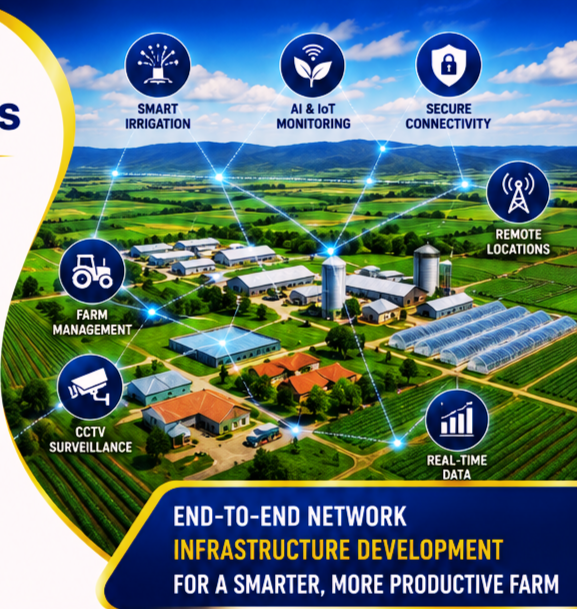
Modern large-scale farms are becoming increasingly dependent on technology. From smart irrigation and connected agricultural equipment to CCTV surveillance, remote monitoring, digital communication and data-driven decision-making, technology is transforming how agricultural operations are managed.
However, these technologies are only as effective as the connectivity infrastructure supporting them.
A large farm can span hundreds or thousands of acres and include farm offices, production fields, warehouses, greenhouses, processing facilities, staff housing, workshops, livestock areas, irrigation systems, equipment yards and remote operational zones. Connecting all these areas reliably requires more than installing a few Wi-Fi access points.
It requires a carefully planned, secure, scalable and end-to-end network infrastructure.
At Fibrecom Solutions, we help large farms design, develop, upgrade and optimise connected ecosystems that support modern agricultural operations.
Why Connectivity Matters in Modern Agriculture
Agriculture is increasingly becoming a data-driven industry.
Farm managers need visibility across different parts of the operation, while workers and automated systems need reliable communication between facilities and field locations.
A well-designed network can support:
- Smart irrigation and water management
- IoT sensors and connected agricultural devices
- CCTV and remote surveillance
- Access control
- Farm management systems
- Digital communication
- Connected machinery and equipment
- Environmental monitoring
- Warehouse and inventory operations
- Processing and production facilities
- Remote farm offices and operational areas
- Cloud-based applications and data systems
The objective is not simply to provide internet access. The objective is to create a digital infrastructure that allows the entire farm ecosystem to communicate, operate and grow efficiently.
The Challenge of Connecting Large Farms
Large farms present unique connectivity challenges.
Buildings may be spread across significant distances, while fields, livestock areas, irrigation points and production zones may be located far from the main administration block.
Traditional network deployment methods may therefore not be sufficient.
A farm may require a combination of fibre optic infrastructure, wireless links, structured cabling, enterprise Wi-Fi and intelligent networking equipment to achieve reliable coverage.
Poorly planned connectivity can result in:
- Network dead zones
- Unreliable communication
- CCTV blind spots
- Poor wireless performance
- Network congestion
- Security vulnerabilities
- Difficulty monitoring remote operations
- Expensive infrastructure modifications
- Limited ability to introduce new technologies
This is why network planning should happen at the ecosystem level, rather than facility by facility.
Our End-to-End Network Infrastructure Approach
At Fibrecom Solutions, we look at the farm as one connected ecosystem.
We assess the existing infrastructure, operational requirements, physical environment, distances between facilities, users, devices, applications and future expansion plans before recommending the appropriate architecture.
1. Fibre Optic Backbone Infrastructure
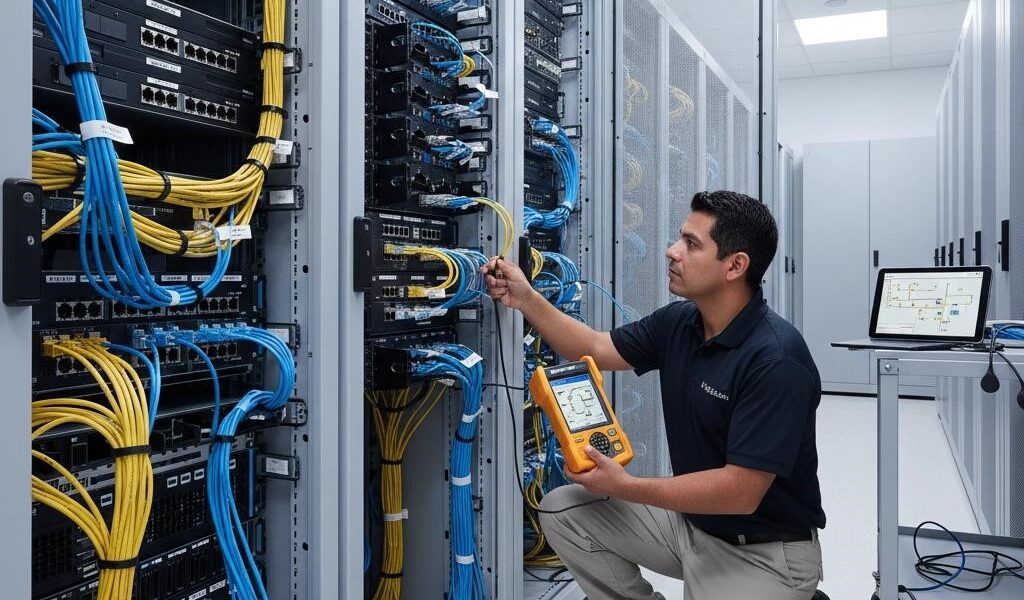
Fibre optic networks provide high-capacity connectivity between major farm facilities.
They can connect:
- Farm headquarters
- Processing plants
- Warehouses
- Control rooms
- Staff facilities
- Security centres
- Workshops
- Production facilities
A strong fibre backbone provides the foundation for high-speed communication and supports bandwidth-intensive applications such as video surveillance, cloud applications and centralised network management.
2. Wireless Connectivity Across Large Farm Areas
Not every part of a farm is practical to connect using physical cabling.
Point-to-point and point-to-multipoint wireless solutions can extend connectivity between distant locations while reducing the need for extensive trenching and cabling.
Wireless connectivity can be used to connect:
- Remote farm offices
- Field operations
- Security points
- Warehouses
- Greenhouses
- Livestock facilities
- Equipment yards
- Remote production areas
This makes it possible to extend the farm’s digital infrastructure beyond its main buildings.
3. Enterprise Wi-Fi
Reliable Wi-Fi is essential in areas where staff and connected devices require mobility.
Enterprise-grade wireless infrastructure can provide controlled and reliable connectivity across offices, warehouses, workshops, staff facilities and other operational areas.
Proper wireless design considers factors such as:
- Building construction
- Coverage requirements
- User density
- Device density
- Interference
- Outdoor coverage
- Concurrent usage
- Application requirements
This helps prevent the common problem of simply installing access points without understanding actual coverage and capacity requirements.
4. AI-Enabled Network Infrastructure
Modern network equipment is becoming increasingly intelligent.
AI-enabled networking technologies can provide improved visibility into network performance, identify unusual behaviour, assist with optimisation and provide more effective monitoring.
For large agricultural operations, this can help network administrators understand:
- Where network congestion is occurring
- Which areas are experiencing connectivity problems
- Device and user behaviour
- Network performance trends
- Potential anomalies
- Infrastructure utilisation
The result is a more visible, manageable and intelligent network environment.
5. CCTV and Video Surveillance
Security is a major consideration for large farms.
CCTV networks can provide visibility across:
- Farm entrances
- Boundaries
- Warehouses
- Equipment yards
- Processing facilities
- Livestock areas
- Fuel storage areas
- Parking areas
- Remote operational zones
A properly designed surveillance network ensures that cameras have reliable connectivity to recording and monitoring systems.
When combined with appropriate network infrastructure, farm management teams can achieve greater visibility across large properties.
6. Access Control Systems
Access control can help farms manage who enters critical areas.
Systems can be deployed at:
- Main gates
- Administration buildings
- Warehouses
- Stores
- Processing facilities
- Server rooms
- Equipment areas
- Restricted operational zones
Connecting access control systems to the broader network infrastructure can improve monitoring and centralised management.
7. Smart Agriculture and IoT Connectivity
The growth of smart agriculture is increasing the number of connected devices deployed on farms.
Sensors and IoT technologies can support applications such as:
- Soil monitoring
- Environmental monitoring
- Irrigation management
- Equipment monitoring
- Water management
- Production monitoring
- Livestock monitoring
These technologies require dependable communication infrastructure.
A well-designed network provides the connectivity foundation needed for agricultural organisations to adopt and expand smart farming technologies.
8. IP Telephony and Communication
Large farms often have teams operating across different locations.
IP-based communication systems can connect management, security, production, administration and operational teams through a common communication infrastructure.
This can improve internal communication while reducing dependence on disconnected communication systems.
9. Network Security
As more agricultural systems become connected, cybersecurity becomes increasingly important.
A modern farm network should incorporate appropriate security measures such as:
- Network segmentation
- Access control policies
- Secure authentication
- Monitoring
- Firewall protection
- Device management
- Controlled access to critical systems
The objective is to ensure that connectivity does not become a vulnerability.
10. Centralised Network Management
Managing connectivity across a large farm can become difficult when systems operate independently.
Centralised network management provides greater visibility into infrastructure performance from a central location.
Farm management and IT teams can gain better visibility into:
- Network devices
- Wireless infrastructure
- Connectivity performance
- Connected devices
- System health
- Traffic patterns
- Potential network issues
This makes it easier to identify problems and plan future improvements.
Let Us Work With You
Every farm is different.
The right solution for one agricultural operation may not be appropriate for another.
Let us work with you in reviewing your existing or planned farm ecosystem and give you the best recommendation.
Our team can assess your:
- Existing network infrastructure
- Farm layout and distances
- Buildings and operational zones
- Connectivity requirements
- User and device density
- Security requirements
- Smart farming technologies
- Future expansion plans
From this assessment, we can recommend an infrastructure strategy that is reliable, scalable, secure and fit for your operation.
Building for Today’s Farm and Tomorrow’s Agriculture
A network designed only for today’s requirements may quickly become inadequate as the farm grows.
New buildings may be constructed. More cameras may be installed. Additional sensors may be deployed. More employees may require connectivity. Smart irrigation and IoT systems may expand.
This is why infrastructure should be designed with scalability and future growth in mind.
A properly engineered network gives your farm the foundation to adopt new technologies without having to completely rebuild the underlying infrastructure.
Why Choose Fibrecom Solutions?
Fibrecom Solutions provides an end-to-end approach to network infrastructure development.
We can support your farm with:
✓ Network assessment and planning
✓ Fibre optic backbone development
✓ Enterprise Wi-Fi deployment
✓ Wireless point-to-point connectivity
✓ Structured cabling
✓ AI-enabled network infrastructure
✓ CCTV and surveillance networking
✓ Access control connectivity
✓ Smart agriculture and IoT connectivity
✓ Network security
✓ Centralised network management
✓ Infrastructure upgrades and optimisation
Whether you are developing a new agricultural operation or upgrading an existing farm, our objective is to help you build a connected, secure and future-ready environment.
The future of agriculture is increasingly connected.
Large farms need infrastructure capable of connecting people, buildings, equipment, security systems, agricultural technologies and remote operational areas.
The right network infrastructure can provide the digital foundation needed to support smarter operations, better visibility, stronger security and future technological growth.
Don’t wait until connectivity problems start affecting your operations.
Let Fibrecom Solutions review your ecosystem, understand your requirements and recommend the right infrastructure for your farm.
Let’s Connect Your Farm for Today and Tomorrow.
📞 Call/WhatsApp: 0743 177 457
🌐 Website: fibrecom.co.ke
📧 Email: info@fibrecom.co.keFibrecom Solutions — Building the connected infrastructure behind smarter environments.