
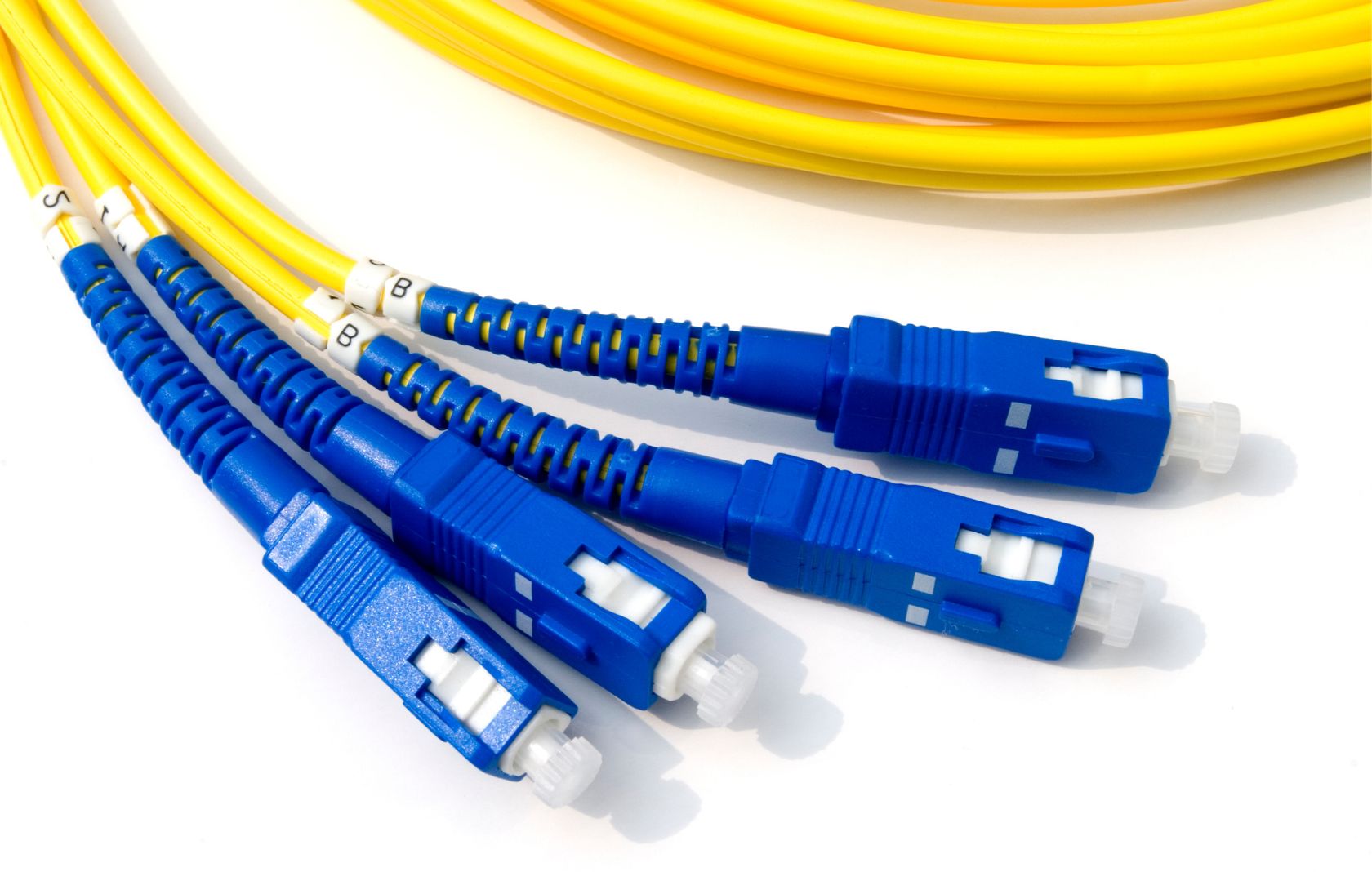

Optical fibre has become one of the most important foundations of modern digital infrastructure. From commercial buildings and residential developments to schools, hospitals, industrial facilities and smart buildings, organisations increasingly depend on fast, stable and scalable connectivity.
But installing optical fibre is not simply a matter of pulling a cable from one point to another.
A professional fibre installation requires planning, design, installation, splicing, termination, testing, documentation and future scalability. When these elements are properly integrated, the result is a network infrastructure that can support today’s applications while preparing the organisation for tomorrow’s connectivity demands.
For businesses and property developers, the real question should therefore not be “Do we have fibre?” but rather:
“Do we have fibre infrastructure that has been properly designed, installed, tested and documented?”
What Is End-to-End Optical Fibre Installation?
End-to-end optical fibre installation covers the complete lifecycle of a fibre network—from understanding the site requirements to handing over a tested and documented infrastructure.
A typical project involves:
- Site survey and assessment
- Fibre network design
- Route planning
- Fibre and equipment selection
- Cable installation
- Fibre splicing
- Termination
- Optical distribution frames and patching
- Testing and certification
- Labelling
- Documentation
- Maintenance and future expansion planning
This integrated approach helps eliminate gaps that can occur when different stages of a fibre deployment are handled without proper coordination.
1. It Starts With a Proper Site Survey
Before any fibre cable is installed, the physical environment needs to be understood.
A site survey examines factors such as:
- Existing network infrastructure
- Cable routes
- Equipment rooms
- Building layouts
- Available ducts and pathways
- Distance between network points
- Potential obstacles
- Environmental conditions
- Power and equipment requirements
- Future expansion requirements
This stage is particularly important for large properties.
A school, hospital, factory, residential development or commercial complex may require fibre connections across multiple buildings or floors. Without proper route planning, installation can become more expensive and difficult to maintain.
Good fibre infrastructure begins with good information.
2. Fibre Design Determines Long-Term Performance
Once the site requirements are understood, the fibre network can be designed.
The design should consider both the organisation’s current requirements and its expected future needs.
Questions that should be considered include:
- How many buildings need to be connected?
- How many network points are required?
- How much fibre capacity is needed?
- What type of fibre is appropriate?
- Where should distribution points be located?
- How will the network be expanded later?
- How will technicians access the infrastructure for maintenance?
A network designed only for today’s requirements may become a limitation as the organisation grows.
A properly designed fibre backbone, on the other hand, can provide the foundation for future services and network expansion.
3. Professional Fibre Installation Matters
Fibre optic cable is highly capable, but it must be installed correctly.
Installation teams need to observe appropriate handling and routing practices to avoid unnecessary stress or damage to the fibre.
This includes paying attention to:
- Bend radius
- Pulling tension
- Cable protection
- Pathway selection
- Separation from unsuitable infrastructure
- Proper cable support
- Environmental conditions
- Labelling and identification
Poor installation practices can introduce problems that may not immediately be visible.
The network may appear to work initially, only for performance issues to emerge later.
That is why installation quality matters as much as the fibre specification itself.
4. Fibre Splicing and Termination Require Precision
Splicing is one of the critical stages of an optical fibre deployment.
A fibre splice joins two fibre strands while maintaining the optical path between them. Poor splicing can introduce excessive loss and compromise network performance.
Termination is equally important because fibre must eventually connect into the active network infrastructure through appropriate components such as patch panels, optical distribution frames and other network equipment.
The objective is to create a clean, organised and maintainable fibre environment.
A professionally terminated fibre installation makes future troubleshooting and expansion significantly easier.
5. Testing Should Never Be an Afterthought
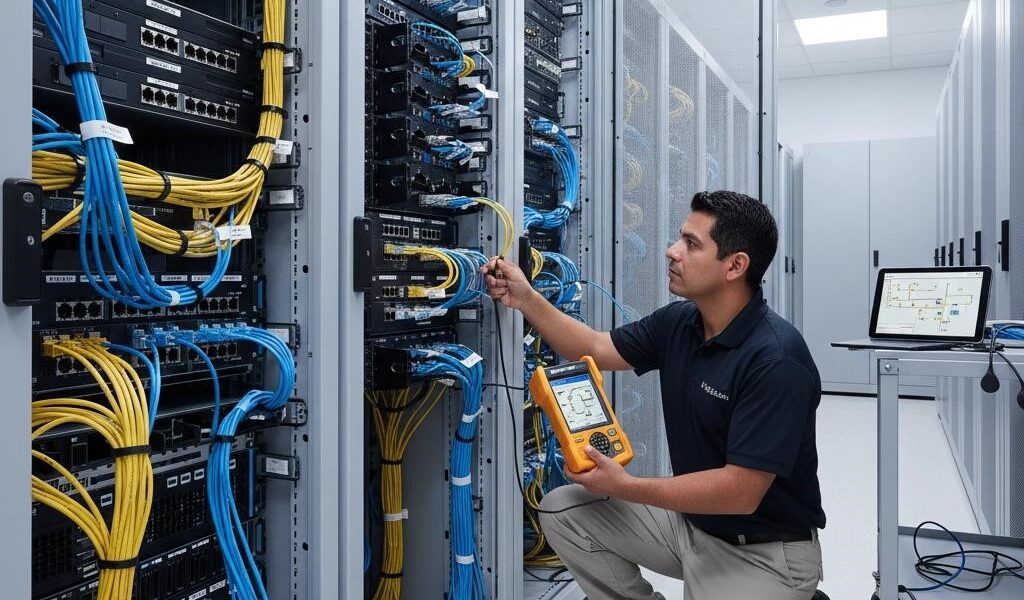
One of the biggest differences between a basic fibre installation and a professional deployment is testing.
A fibre link should not simply be declared complete because a connection is active.
Testing helps determine whether the installed infrastructure is performing as expected.
Depending on the project requirements, testing may include:
- OTDR testing
- Optical power testing
- Insertion loss testing
- Continuity testing
- Connector inspection
Testing can help identify issues such as excessive attenuation, poor splices, damaged fibre or connector problems.
This provides the customer with greater confidence that the infrastructure has been properly installed.
If fibre has been installed but not properly tested, you may know that the link works—but not necessarily how well it works.
6. Documentation Makes Infrastructure Easier to Manage
Another commonly overlooked part of fibre deployment is documentation.
A network can be physically excellent but difficult to manage if nobody knows:
- Where each fibre runs
- Which cores are in use
- Where each fibre terminates
- Which equipment is connected
- Where splice points are located
- Which pathways are being used
Proper documentation creates a reference point for future maintenance and expansion.
It can also significantly reduce troubleshooting time when a fault occurs.
For large organisations and property developments, this becomes even more important as infrastructure grows.
Fibre Infrastructure for Different Industries
The need for reliable optical fibre extends across virtually every sector.
Commercial Buildings
Commercial properties require reliable connectivity for tenants, staff, security systems, cloud applications, voice communication and other digital services.
A strong fibre backbone can provide the infrastructure needed to connect different floors, departments and building systems.
Residential Developments
Modern residential developments increasingly depend on connectivity as an important part of the tenant and homeowner experience.
Fibre infrastructure can support internet connectivity alongside other technologies deployed across the development.
Schools and Institutions
Educational institutions need connectivity for digital learning, administration, surveillance, Wi-Fi and cloud-based systems.
A well-designed fibre backbone can connect administration blocks, classrooms, laboratories, libraries, hostels and other facilities.
Healthcare Facilities
Hospitals and healthcare facilities rely heavily on digital systems.
Reliable infrastructure can support connectivity between departments, security systems, communication platforms and other technology environments.
Industrial Facilities
Factories and industrial sites may have large physical areas requiring connectivity between offices, production facilities, warehouses, security points and other locations.
Fibre can provide a high-capacity backbone across the site.
Hotels and Hospitality
Hotels increasingly depend on connectivity for guest services, Wi-Fi, surveillance, access control, communications and operational systems.
A properly planned fibre infrastructure can support these interconnected technologies.
What Happens When Fibre Infrastructure Is Poorly Designed?
Many organization’s only discover infrastructure weaknesses after problems appear.
These may include:
Slow or unstable connections
Poor fibre installation, excessive loss or faulty components can affect network performance.
Frequent network outages
Unprotected or poorly routed fibre can become vulnerable to physical damage.
Difficult troubleshooting
Poor labelling and inadequate documentation can make fault finding unnecessarily difficult.
Expensive upgrades
A network designed without future expansion in mind may require significant rework when demand increases.
Unnecessary downtime
Poor installation practices can create problems that require repeated intervention.
These issues are not simply technical inconveniences. They can affect productivity, customer experience and operational continuity.
Building Fibre Infrastructure for the Future
Digital infrastructure requirements continue to evolve.
Organisations are adopting:
- Cloud services
- IP surveillance
- Access control
- Unified Communications
- Enterprise Wi-Fi
- IoT
- Smart building systems
- Digital collaboration
- Data-intensive applications
All of these technologies depend on reliable network infrastructure.
This is why optical fibre should be considered as part of the broader connected ecosystem rather than as a standalone installation.
The fibre backbone should provide a strong foundation upon which other technologies can operate.
Why Choose an End-to-End Approach?
Working with an end-to-end infrastructure partner brings the different stages of deployment together.
Instead of treating design, installation, splicing, testing and documentation as disconnected activities, the entire project can be managed as one infrastructure solution.
This can provide:
Better coordination – Design and installation remain aligned.
Greater visibility – The customer has a clearer understanding of what has been deployed.
Improved reliability – Testing and quality control are incorporated into the project.
Simpler maintenance – Proper documentation and labelling make future interventions easier.
Future scalability – The network can be designed with expansion in mind.
Fibrecom Solutions: Building More Than a Fibre Link
At Fibrecom Solutions, optical fibre is approached as a critical component of the wider ICT infrastructure.
Our end-to-end approach covers the journey from assessment and design through installation, splicing, termination, testing and documentation.
Whether the requirement involves a commercial building, residential development, school, hospital, industrial facility or large compound, the objective is the same:
Build reliable infrastructure that works today, can be maintained tomorrow and is ready for future growth.
If you are planning a new fibre installation, extending an existing network or experiencing recurring fibre-related connectivity problems, the right starting point is a professional assessment of your infrastructure requirements.