

Why Access Control Is Essential for Developers, Institutions and Large Establishments
Security is no longer simply about putting a lock on a door, hiring a security guard or installing a perimeter gate.
Modern facilities are complex environments. They have employees, visitors, residents, students, contractors, suppliers and service providers moving through different areas every day.
Some areas are public. Others are restricted. Some contain highly sensitive information, equipment or valuable assets.
This raises an important question for every property developer, institution, facility manager and business owner:
Can you control, monitor and manage who accesses your facility and where they are authorized to go?
This is where a properly designed access control system becomes an essential part of modern building infrastructure.
What Is an Access Control System?
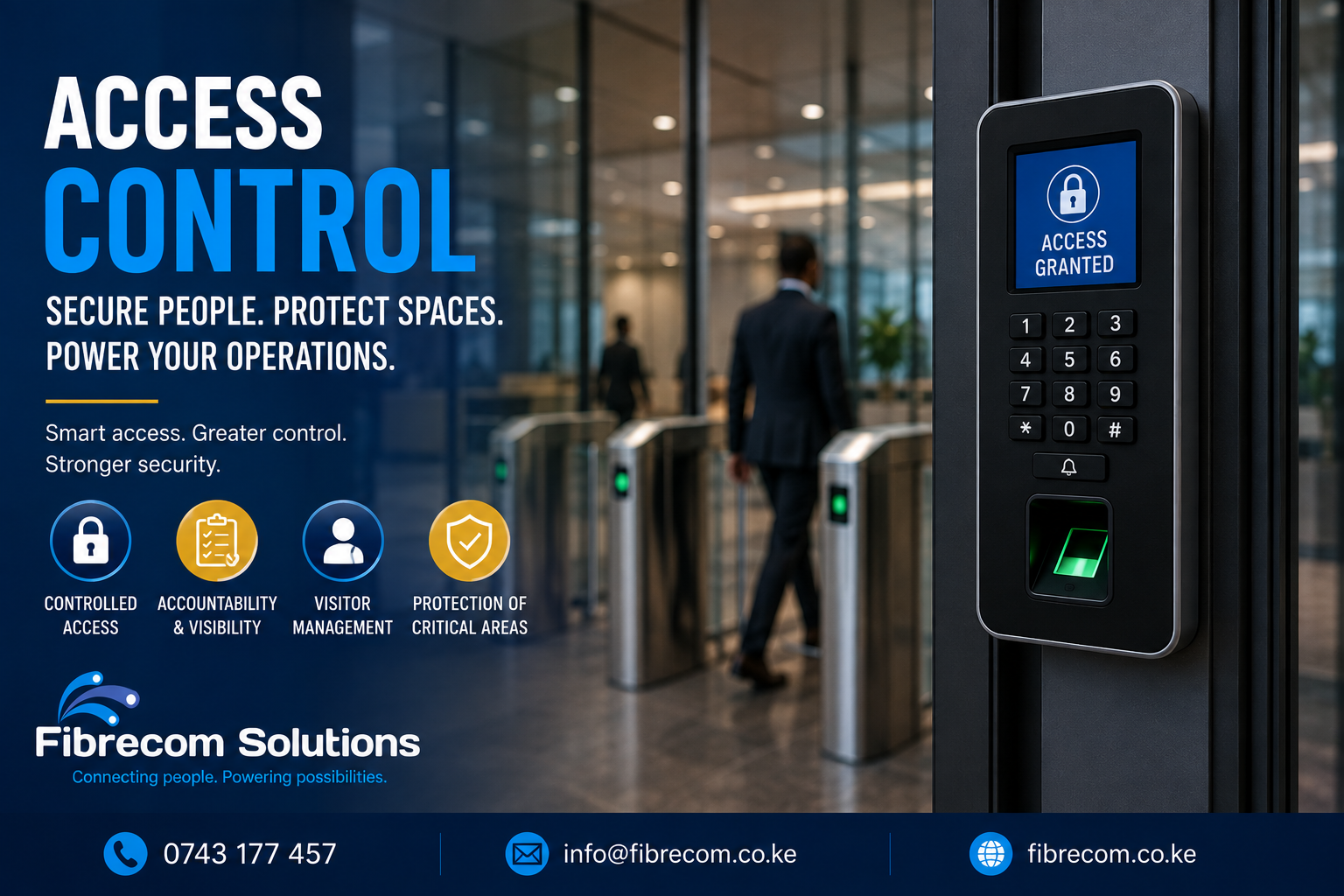
An access control system is a security solution that determines who is permitted to enter a building, room or restricted area, when they can enter and what areas they are authorized to access.
Depending on the requirements of a facility, access can be managed using:
- Access cards and RFID credentials
- PINs and electronic keypads
- Biometric identification
- Mobile credentials
- Electronic locks
- Turnstiles
- Gate access systems
- Visitor management systems
The objective is not simply to prevent unauthorized entry.
A properly designed system provides security, visibility, accountability, convenience and better control over movement within a facility.
1. Controlled Access to Your Facility
Traditional keys can be lost, copied or transferred between people without giving management meaningful visibility.
With an access control system, organizations can assign permissions according to individuals, roles, departments or locations.
For example, an employee may have access to the main entrance and their department but not to the server room or finance office.
A school can establish different access permissions for teachers, administrators, students, visitors and maintenance personnel.
A residential development can manage access for residents, guests, contractors and property management teams.
This creates a more structured approach to physical security.
2. Protect Critical and Sensitive Areas
Not everyone within a facility should have unrestricted access.
Consider areas such as:
- Server and data rooms
- Executive offices
- Financial departments
- Laboratories
- Stores and warehouses
- Electrical and utility rooms
- Security control rooms
- Research facilities
- Records and archives
An access control system allows these areas to have additional layers of protection.
Instead of relying entirely on physical keys, organizations can establish permission-based access and maintain records of authorized entry.
3. Improve Accountability and Visibility
One of the major advantages of electronic access control is the ability to maintain access records.
Management can potentially determine:
Who accessed an area?
When did they access it?
Which access point was used?
This information can improve accountability and support security investigations when incidents occur.
It can also give facility managers better visibility into how buildings are being used.
4. Improve Visitor Management
Large facilities often struggle with visitor management.
A manual visitor book may record a visitor’s name and telephone number, but it may not provide sufficient control over where that visitor can go.
A modern visitor management and access control solution can help organizations establish a structured process for:
- Visitor registration
- Authorization
- Identification
- Access assignment
- Monitoring
- Visitor exit
This is particularly valuable for corporate offices, hospitals, schools, residential developments, government facilities and large commercial properties.
5. Access Control Can Scale With Your Development
Developers should think beyond a single door.
A large development may contain:
- Multiple buildings
- Parking facilities
- Main gates
- Reception areas
- Residential blocks
- Commercial spaces
- Offices
- Utility areas
- Recreational facilities
A properly planned access control architecture can provide centralized or coordinated management across multiple access points.
This makes the system suitable for developments that are expected to grow over time.
Why Developers Should Plan Access Control Before Construction
One of the common mistakes in building projects is treating security as something to be installed after construction is complete.
By then, the building may already have finished walls, ceilings, electrical installations and network infrastructure.
Retrofitting access control can therefore become disruptive, expensive and difficult to coordinate.
Security should be designed alongside the building.
During the planning stage, developers should consider access control together with:
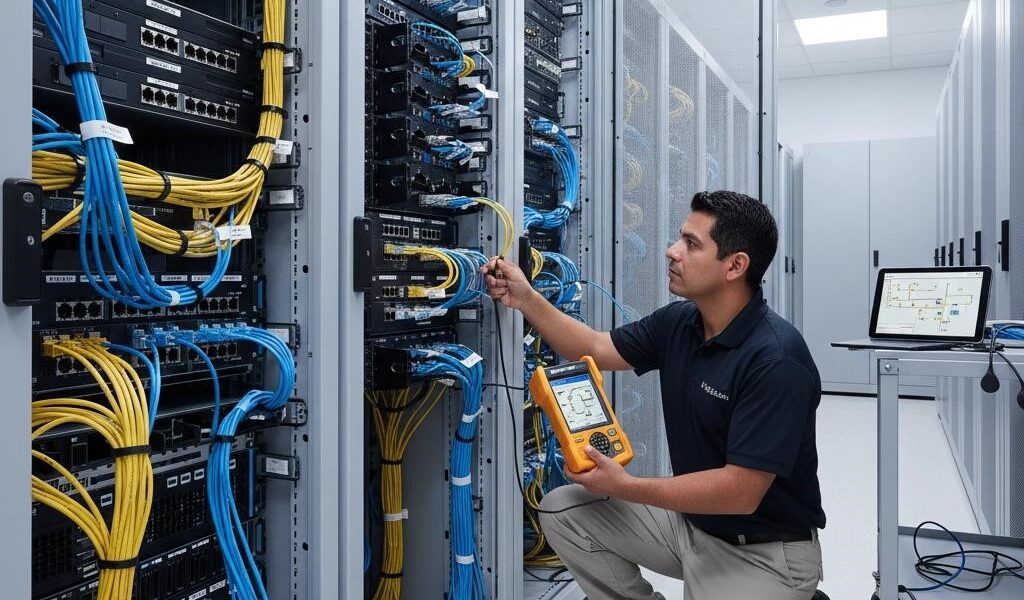
- Structured cabling
- Fibre infrastructure
- Network infrastructure
- CCTV
- Power and backup power
- Intercom systems
- Alarm systems
- Visitor management
- Smart building technologies
This creates an integrated infrastructure ecosystem rather than a collection of disconnected security devices.
Access Control Should Not Operate in Isolation
The real value of modern security infrastructure comes from integration.
Access control can form part of a broader ecosystem involving CCTV, networking, alarms, intercoms and smart building technologies.
For example, when someone accesses a restricted door, the access control system can verify their credentials while CCTV provides visual monitoring of the area.
The network infrastructure connects the systems, while alarms can provide additional notifications when defined security events occur.
This creates greater visibility than relying on a single security measure.
Think of it as a connected security ecosystem:
Access Control + CCTV + Network Infrastructure + Alarms + Intercom + Visitor Management + Smart Building Technology
The result is a more coordinated approach to facility security and management.
What Should Decision-Makers Consider Before Choosing an Access Control System?
Before purchasing equipment, organizations should first understand their operational requirements.
1. How many people require access?
Employees, residents, students, contractors and visitors may require different access policies.
2. How many access points need protection?
Consider gates, doors, offices, floors, parking areas and restricted rooms.
3. Which areas require higher security?
Not every door requires the same level of authentication.
4. How will visitors be managed?
Visitor access should be considered as part of the overall security strategy.
5. Does the system need to integrate with CCTV and other infrastructure?
Integration requirements should be established before equipment is selected.
6. Can the system scale?
A solution that works for a small facility today may not be appropriate when the organization expands.
7. What happens when the system fails?
Power backup, network resilience, emergency access procedures and maintenance should form part of the design.
The Bigger Picture: Building Secure, Connected Facilities
For developers and institutions, access control is not merely a security product.
It is part of the building infrastructure strategy.
When properly designed, it contributes to:
Security — controlling unauthorized access.
Accountability — improving visibility of access activity.
Operational efficiency — reducing dependence on traditional keys and manual processes.
Scalability — supporting growing facilities and multiple access points.
Integration — connecting security systems into a broader technology ecosystem.
Future readiness — creating infrastructure that can accommodate evolving technologies.
A modern building should not simply be constructed to look good.
It should be designed to be secure, connected, manageable and adaptable.
Build Security Into the Project—Not After It
Whether you are developing a residential estate, school, hospital, office complex, warehouse, industrial facility or commercial property, security infrastructure should be considered from the beginning.
The right question is not:
“Do we have locks?”
The better question is:
“Can we control, monitor and manage access across our entire facility?”
That shift in thinking can make the difference between a building with individual security devices and a properly integrated security infrastructure.
How Fibrecom Solutions Can Help
At Fibrecom Solutions, we help developers, institutions and large organizations design and deploy integrated network, security and smart infrastructure solutions tailored to their operational requirements.
Our solutions can bring together:
- Access Control Systems
- CCTV Systems
- Network Infrastructure
- Structured Cabling
- Fibre Infrastructure
- Alarm Systems
- Intercom & Visitor Management
- Smart Building Solutions
We focus on designing infrastructure around the facility—not simply supplying equipment.
Planning a new development or upgrading an existing facility?
Engage your infrastructure partner before installation begins.
📞 Call / WhatsApp: 0743 177 457
📧 Email: info@fibrecom.co.ke
🌐 Website: fibrecom.co.ke
Build Secure. Build Smart. Build with Fibrecom.