

Modern developments are no longer simply collections of buildings. They are complex, technology-driven ecosystems where connectivity, security, communication, energy, automation and operations must work together.
A large estate may have residential units, offices, a clubhouse, security gates, parking areas, recreational facilities and commercial spaces. A farm may include administration offices, staff housing, greenhouses, processing facilities, storage areas, irrigation systems and large outdoor spaces. A school may have classrooms, laboratories, libraries, hostels, administration blocks, dining facilities, sports grounds and security systems.
Each of these areas requires reliable connectivity.
The challenge is that many developments install technology one system at a time. Wi-Fi is installed separately. CCTV comes later. Access control is added when security becomes a concern. Structured cabling is expanded as new buildings are constructed.
This approach can create fragmented infrastructure that is difficult and expensive to manage.
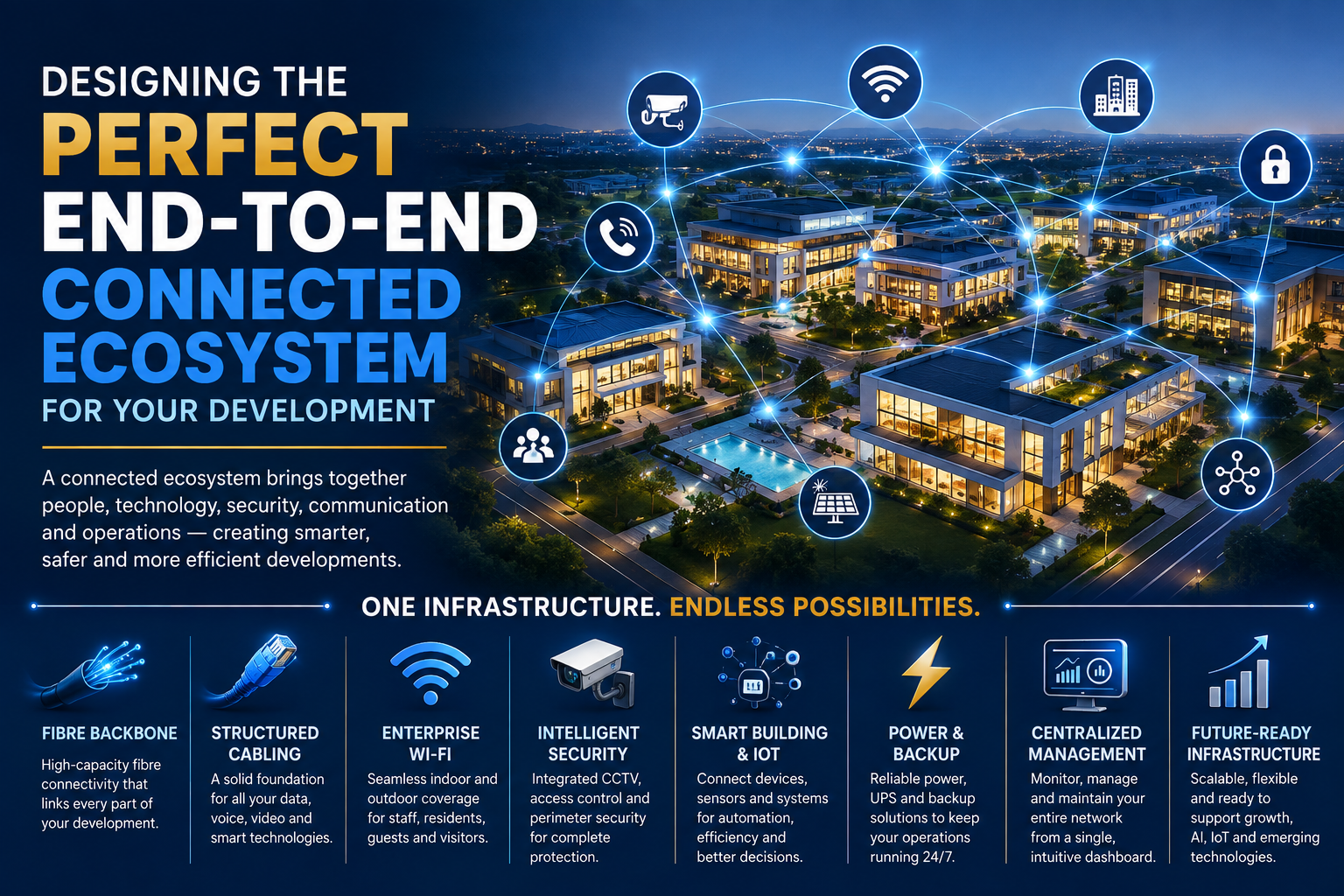
The better approach is to design the entire development as one connected ecosystem from the beginning.
The Problem with Disconnected Infrastructure
One of the biggest challenges facing modern developments is the absence of a unified infrastructure plan.
When individual systems are deployed without considering how they will work together, several problems can emerge.
1. Poor Network Coverage
Large developments often have buildings separated by significant distances. A standard consumer Wi-Fi solution may provide adequate coverage in one building but fail across outdoor areas, additional blocks and remote facilities.
The result is weak connectivity, dead zones and frustrated users.
2. Security Blind Spots
CCTV cameras, access control systems and perimeter security require reliable network infrastructure.
If connectivity was not properly planned, some areas may remain difficult to monitor, creating security gaps.
3. Increasing Technology Demands
The number of connected devices continues to grow.
Computers, smartphones, CCTV cameras, biometric systems, smart sensors, access control devices, televisions, IoT equipment and other connected technologies all compete for network resources.
Infrastructure that was sufficient several years ago may quickly become inadequate.
4. Difficult Network Management
When different systems are installed independently, troubleshooting becomes harder.
A connectivity problem may affect CCTV, access control, Wi-Fi or other operational systems, making it difficult to determine where the actual fault originates.
5. Expensive Future Upgrades
Retrofitting infrastructure after buildings are completed can be disruptive and costly.
Running new cables, installing additional network equipment or creating new communication links may require construction work that could have been avoided through proper initial planning.
The Solution: An End-to-End Connected Ecosystem
The answer is to treat the development as one infrastructure project rather than a collection of independent technology projects.
An end-to-end approach begins with understanding the entire development, its current requirements, future needs, physical layout and operational objectives.
The infrastructure can then be designed around these requirements.
1. Build a Strong Fibre Backbone
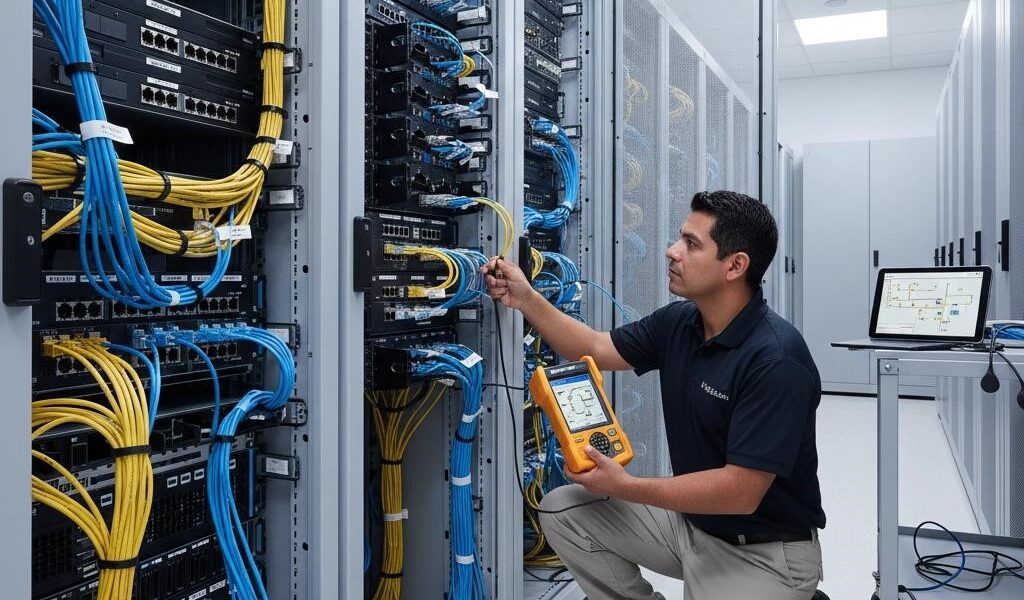
A reliable fibre backbone provides the foundation for connecting multiple buildings and operational areas.
Fibre can provide high-capacity communication between administration blocks, residences, offices, security facilities, accommodation units, production areas and other critical locations.
A properly designed backbone also provides the scalability required as the development expands.
2. Deploy Professional Structured Cabling
Structured cabling provides the physical foundation for many technologies within a building.
It can support:
- Data networks
- Voice communication
- Wi-Fi access points
- CCTV
- Access control
- Smart building systems
- IoT devices
- Other network-enabled technologies
Rather than adding cables every time a new technology is introduced, a properly designed cabling infrastructure provides a more organized and scalable foundation.
3. Design Enterprise-Grade Wi-Fi Coverage
Connectivity should not stop at the office door.
Modern developments require wireless access across the areas where people work, live, study, interact and operate.
This may include:
- Offices
- Residences
- Classrooms
- Guest cottages
- Common areas
- Parking areas
- Outdoor recreational spaces
- Farm operations
- Hospitality facilities
Professional wireless planning helps identify coverage requirements and strategically position access points for better performance.
4. Integrate Intelligent Security
Security should be part of the network design rather than an isolated system.
A connected security ecosystem can bring together:
- CCTV surveillance
- Access control
- Perimeter monitoring
- Gate security
- Visitor management
- Smart locks
- Centralized monitoring
Reliable connectivity allows security systems to communicate efficiently and provides management teams with better visibility across the development.
5. Introduce Smart Building and IoT Technologies
The connected development of the future will contain more intelligent devices and sensors.
Depending on the environment, these may support:
- Energy monitoring
- Environmental monitoring
- Smart lighting
- Occupancy monitoring
- Equipment monitoring
- Automated systems
- Asset tracking
- Operational alerts
The network therefore needs to be designed with IoT growth in mind.
6. Plan for Power and Network Resilience
Connectivity is only useful when the infrastructure has reliable power.
Network equipment, CCTV systems, access control, servers and other critical technology may require UPS systems, solar solutions, backup power and appropriate power protection.
A resilient connected ecosystem considers both data connectivity and power continuity.
7. Centralize Monitoring and Management
As the number of connected devices increases, centralized management becomes increasingly important.
Network administrators should be able to understand the status of critical infrastructure, identify faults, monitor performance and respond to problems efficiently.
This can reduce downtime and make maintenance more proactive rather than purely reactive.
Design for the Future, Not Just Today
One of the most important principles in network infrastructure development is scalability.
Your development will change.
More buildings may be added. More residents, students, employees or guests may use the network. More cameras may be installed. More smart devices may be introduced.
Artificial intelligence and IoT technologies will continue creating new demands on infrastructure.
That means today’s network should not simply solve today’s problems.
It should create a foundation for tomorrow.
A future-ready design considers:
Capacity → Coverage → Security → Reliability → Scalability → Manageability
When these elements are considered together, infrastructure becomes an asset that supports long-term growth.
Who Needs an End-to-End Connected Ecosystem?
This approach is particularly valuable for developments with multiple buildings, facilities and operational areas.
Estates & Gated Communities
Connect residential units, management offices, gates, CCTV, amenities, parking areas and common spaces.
Farms & Agricultural Projects
Connect farm offices, staff facilities, processing areas, greenhouses, warehouses, security points and remote operational areas.
Schools & Universities
Create reliable connectivity across classrooms, laboratories, libraries, administration offices, hostels, dining facilities and recreational areas.
Hospitals & Healthcare Facilities
Support connectivity between departments, administrative offices, security systems and technology-enabled medical environments.
Hotels, Cottages & Staycation Facilities
Provide seamless connectivity for guests while supporting CCTV, access control, staff operations and smart hospitality technologies.
Commercial & Industrial Developments
Connect offices, warehouses, production areas, security systems, equipment and operational facilities through a structured infrastructure.
From Buildings to a Connected Ecosystem
The goal is not simply to install more technology.
The goal is to make technology work together intelligently.
Imagine a development where:
A visitor arrives at the gate and the security system records the entry.
The network securely connects the gate to the central management system.
CCTV provides visibility across the property.
Access control manages authorized movement.
Enterprise Wi-Fi keeps staff and users connected.
Smart devices provide operational information.
Power backup protects critical systems during interruptions.
And centralized management provides visibility into the entire infrastructure.
That is the difference between having technology and having a connected ecosystem.
Why Professional Design Matters
A successful connected ecosystem begins long before equipment is installed.
It requires:
Site assessment → Network design → Capacity planning → Infrastructure deployment → Configuration → Testing → Documentation → Monitoring → Preventive maintenance
Professional planning helps eliminate unnecessary duplication, improve reliability and create infrastructure that can evolve with the development.
Instead of repeatedly fixing individual connectivity problems, property owners and developers can move toward a structured, strategic infrastructure model.
Fibrecom Solutions: Building the Infrastructure Behind Connected Developments
At Fibrecom Solutions, we help organizations design, deploy, upgrade and optimize end-to-end technology infrastructure for complex developments.
Our solutions can integrate:
- Fibre optics
- Structured cabling
- Networking
- Enterprise Wi-Fi
- CCTV
- Access control
- Smart building technologies
- IoT infrastructure
- Power solutions
- Network management
- Preventive maintenance
- Future-ready infrastructure
Whether you are developing a large estate, farm, school, hospital, hotel, cottage facility, office complex or industrial site, we can help you move from fragmented systems to a coordinated connected ecosystem.
Build the Development. Connect the Ecosystem. Power the Future.
Don’t wait until poor connectivity, security gaps or network limitations become expensive problems.
Design the infrastructure early. Build it correctly. Make it scalable.
Your development deserves more than isolated technology.
It deserves an end-to-end connected ecosystem designed to support today’s operations and tomorrow’s possibilities.
Get in Touch
📞 Call / WhatsApp: 0743 177 457
📧 Email: info@fibrecom.co.ke
🌐 Website: www.fibrecom.co.ke
Fibrecom Solutions — Connect • Power • Protect